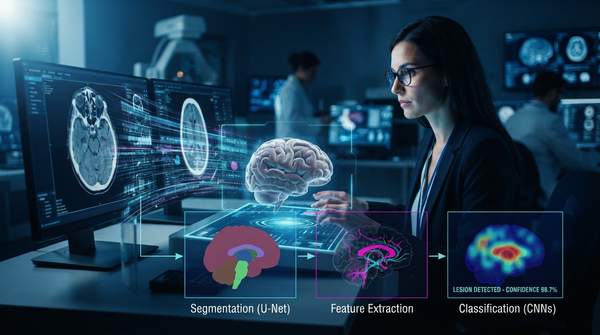
Artificial intelligence is fundamentally altering the process of discovering, developing, and delivering new medicines. From identifying disease targets in the earliest stages of research to monitoring patient safety after a drug is on the market, AI is being integrated across the entire pharmaceutical lifecycle. The U.S. Food and Drug Administration's Center for Drug Evaluation and Research (CDER) confirms this trend, noting it has seen a "significant increase in the number of drug application submissions using AI components over the past few years." This transformation promises to accelerate timelines and improve precision, but it also introduces significant challenges related to data quality, model transparency, and regulatory oversight that the industry must navigate.
AI's Journey Through Drug Development: An Explanatory Model
Artificial intelligence is not a single tool but a collection of technologies applied to specific problems at distinct points in the pharmaceutical pipeline. Its role evolves from sifting through immense biological datasets to optimizing complex human trials. The following model provides a high-level overview of where and how AI is making an impact, with subsequent sections exploring each stage in greater detail.
| Stage of Development | AI Application and Purpose |
|---|---|
| Target Identification & Validation | In the initial discovery phase, AI tools scan vast biological datasets to identify new proteins implicated in diseases. By exploring the complex "chemical space," these systems help researchers pinpoint promising drug targets more quickly than traditional methods. |
| Preclinical Research | AI models predict how a potential drug will behave in the body, assessing its absorption, distribution, metabolism, excretion, and toxicity (ADMET). This virtual screening helps prioritize which compounds to synthesize and test, focusing resources on the most promising candidates and mitigating late-stage development risks. |
| Clinical Trials | AI is used to improve the design of clinical trials and accelerate patient recruitment. By analyzing data from electronic health records, genetic information, and medical literature, AI can help match the right patients to the right trials, potentially improving the likelihood of a successful outcome. |
| Post-Market Monitoring | After a drug is approved and available to patients, AI systems assist in ongoing safety monitoring. This allows for continuous learning and rapid identification of potential adverse effects in a broad population. |
AI's Role in Target Identification and Validation
The drug discovery process begins with identifying a biological target, such as a protein, that is implicated in a disease. Traditionally a slow and painstaking process, this initial step is being accelerated by AI. According to a report in Chemical & Engineering News, companies are using advanced AI tools to scan for new proteins and explore the vast "chemical space" to find drugs that can interact with them. This computational approach allows researchers to analyze complex biological and chemical data at a scale and speed that is impossible for humans alone, helping to suggest promising drug targets and advance potential medicines faster.
Accelerating Preclinical Research with AI
Once a target is identified, the preclinical phase involves designing and testing compounds that might act on it. Here, AI is reshaping how drug candidates are selected and screened. A key application is the prediction of a compound's ADMET properties—its absorption, distribution, metabolism, excretion, and toxicity. According to an article in Drug Discovery News, AI-powered ADMET prediction is changing drug candidate screening. Machine learning models for drug metabolism are considered a relatively mature application, partly because of the deep public training data available. These predictions can guide drug design and facilitate early-stage toxicity screening. For instance, there is a significant demand for models that can predict drug-induced liver injury (DILI), a common cause of late-stage drug failure, to help mitigate development risk.
AI's Impact on Clinical Trial Efficiency
The clinical trial phase is the longest and most expensive part of drug development. AI offers powerful tools to improve efficiency and increase the probability of success. Companies are deploying AI to enhance clinical trial design and patient recruitment. By analyzing diverse data sources such as patient genetic data, electronic health records, and medical literature, AI can help match the right patients to specific trials. This not only speeds up the recruitment process but also helps ensure that the trial population is appropriate for the drug being tested. This data-driven approach can also help predict potential clinical toxicity, allowing for better trial design and improved patient safety.
The Foundational Challenge of Data
The effectiveness of any AI system is fundamentally dependent on the data used to train it, which presents a major hurdle in the pharmaceutical industry. A review published by the National Library of Medicine highlights that a key issue is the "reliance on large volumes of high-quality data." The scarcity of such data, particularly for rare diseases or uncommon toxicological events, severely constrains the ability of models to learn and make accurate predictions. Furthermore, biases present in historical training datasets can lead to unfair or inequitable AI outcomes. The problem is compounded by "data silos," where valuable information is trapped within individual organizations, hindering the broader sharing and utilization needed to build more powerful and reliable models.
The 'Black Box' Problem and Interpretability
Even with perfect data, the nature of some advanced AI algorithms creates a challenge of trust and transparency. The "black box" issue, as described in a National Library of Medicine review, arises when the internal decision-making processes of a complex model are difficult for human experts to understand. This lack of interpretability is a significant concern in a field where understanding the "why" behind a prediction is critical for patient safety and regulatory approval. When an AI model suggests a novel drug compound or predicts a safety risk, researchers and regulators need to be able to scrutinize its reasoning. To address this, some approaches integrate human oversight into the process. For example, predictions generated with low confidence can be automatically flagged for human review, creating a system of checks and balances that enhances the model's trustworthiness.
Navigating the Future of AI in Pharma
As AI becomes more embedded in drug development, establishing clear regulatory and ethical frameworks is paramount. The application of AI in medicine holds immense promise, but its potential is tempered by these operational and oversight challenges. According to a review in the National Library of Medicine, "Early collaboration between companies and regulatory agencies is vital for ensuring the compliance of AI models and enhancing their credibility."
To move forward effectively, pharmaceutical companies and regulatory bodies must prioritize collaborative efforts to establish clear frameworks and standards for AI model validation and data governance. The development of robust verification plans to validate AI models and conduct ongoing assessments of their reliability will be crucial. Progress in this area will be marked by an increased publication of regulatory guidance documents and industry-wide best practices for AI model development, validation, and data sharing.
Sources
- How AI is transforming the drug innovation lifecycle — PhRMA
- How AI is taking over every step of drug discovery — Chemical & Engineering News
- Drugdiscoverynews
- Computational toxicology in drug discovery — PMC
- Frontiers | Recent advances in AI-based toxicity prediction for drug discovery
- The future of pharmaceuticals: Artificial intelligence in drug discovery and development - PMC