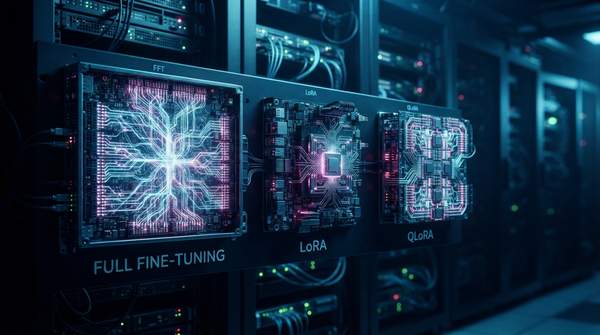
For most enterprise teams, the right fine-tuning choice is decided before any training run begins: it is decided by GPU memory. Full fine-tuning rewrites every weight of a pre-trained model and demands enough memory to hold not just the weights but also optimizer states, gradients, and forward activations during training. LoRA (Low-Rank Adaptation) freezes those weights and trains only small injected matrices, and QLoRA pairs that approach with a quantized base model, extending low-memory fine-tuning to the most hardware-constrained environments. This guide explains the architectural differences behind those three options and maps them onto the practical trade-offs—computational cost, memory footprint, and specialization potential—that determine which one fits a given project.
Navigating LLM Fine-Tuning for Enterprise
Enterprises fine-tune because base models, while broadly capable and quick to deploy, tend to hallucinate more in specialized contexts and lack consistent formatting in structured tasks, whereas fine-tuned models can enforce domain vocabulary, reduce error rates, and produce more consistent structured outputs such as JSON and SQL, as Fireworks AI's fine-tuning guide explains. The question is rarely whether to specialize a model, but how. The chosen technique determines how much proprietary data is needed, what hardware the training run requires, and how deeply the model can absorb the target domain—constraints that interact with one another rather than trading off in simple pairs.
The three dominant approaches occupy different points on that spectrum. Full fine-tuning treats adaptation as a retraining exercise; parameter-efficient methods such as LoRA treat it as a surgical augmentation; and QLoRA combines that augmentation with a compressed base model. Understanding why they differ in cost requires looking first at what each one actually changes inside the model.