Macaque monkeys are already navigating virtual reality environments using only their thoughts, revealing the profound potential of brain-computer interfaces. The navigation of virtual reality environments by macaque monkeys using only their thoughts, reported by Science | AAAS, demonstrates how direct neural signals can precisely control external devices. Such advancements hint at a future where individuals regain lost motor functions or interact with technology mind-to-machine.
Yet, BCI technology, while promising for restoring function and treating neurological disorders, faces significant hurdles. Its current state is plagued by signal acquisition challenges and a lack of long-term clinical validation.
Reliable, ethically sound BCI applications for the general public are likely many years away, according to projections from the early 2020s. They require major advancements in signal processing, user adaptation, and regulatory frameworks.
Connecting Minds and Machines: The BCI Landscape
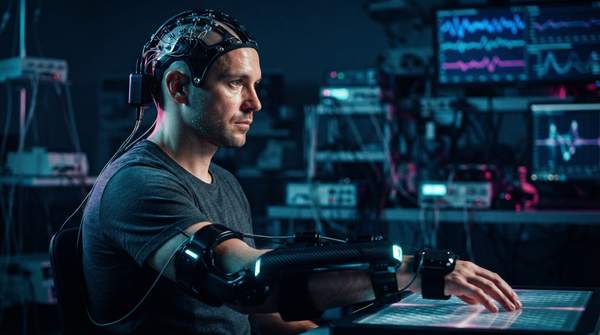
Brain-computer interfaces (BCIs) create a direct communication pathway between the brain and an external device, bypassing the body's peripheral nervous system. These systems use both surface-level and implanted methods to address diverse neurological conditions and medical needs. Non-invasive BCIs, like surface electroencephalography (EEG), measure brain activity from outside the skull, capturing electrical signals through scalp electrodes, according to Brainaccess. Conversely, invasive BCIs involve electrode probes inserted directly into the brain, enabling more precise signal capture.
BCI technology offers solutions for diagnosing, treating, and rehabilitating neurological disorders such as Parkinson's disease, stroke, and spinal cord injury, extending to accessibility, psychology, neurology, pediatric care, and personalized medicine, as noted by PMC. BCI technology's foundational ability to translate thought into action opens new frontiers for human-machine interaction across various medical fields.
How BCIs Work: Invasive vs. Non-Invasive Approaches
Invasive BCIs record neural activity with exceptional spatial and temporal precision, targeting specific neural populations, as noted by Brainaccess. The exceptional spatial and temporal precision of invasive BCIs enables sophisticated control, like macaque monkeys navigating virtual reality with their thoughts, reported by Science | AAAS. Such precision is crucial for complex tasks, promising intricate functional restoration.
Non-invasive BCIs, like EEG or fNIRS systems, must avoid interpreting non-brain signals such as cranial electromyography (EMG) as brain signals, according to PubMed. The fundamental challenge of non-invasive BCIs avoiding interpretation of non-brain signals compromises their reliability. While surface EEG is safe, non-invasive, and cost-effective, its signal purity issues create a critical trade-off between user convenience and data integrity. Invasive methods offer superior neural precision, yet research continues to refine both approaches, aiming to overcome their inherent limitations.
The Hurdles Ahead: Challenges for Widespread BCI Adoption
Widespread BCI adoption faces significant technical hurdles, including robust signal acquisition, processing, and optimizing user training, according to PMC. Companies promoting non-invasive BCI solutions for broad medical use likely overstate their immediate utility. Non-invasive BCIs struggle to distinguish brain signals from cranial EMG, making them unreliable for critical applications demanding precision. The signal purity issue, where non-invasive BCIs struggle to distinguish brain signals from cranial EMG, is a more fundamental technical hurdle than often acknowledged.
Beyond technical challenges, interdisciplinary collaboration and ethical considerations are crucial for BCI development, as PMC emphasizes. Despite impressive precision in animal studies, like macaque virtual reality navigation, current BCI research lacks long-term clinical efficacy and standardized protocols. The lack of long-term clinical efficacy and standardized protocols in current BCI research means laboratory demonstrations are far from validated for safe, effective, and standardized human use, creating a significant gap between concept and practical application.
The BCI industry's focus on technical innovation alone is insufficient. The true bottleneck for adoption lies not just in engineering, but in the complex, slow process of building scientific and societal trust. This demands addressing data privacy, user autonomy, and equitable access to ensure these powerful tools serve humanity responsibly.
Navigating the Future of Brain-Computer Interfaces
As BCI technology advances, a thoughtful, critical perspective on its immediate capabilities and long-term trajectory is essential. Impressive laboratory demonstrations, especially with invasive methods, represent foundational steps, not ready-for-market solutions. The significant investment and inherent risks of brain surgery limit invasive BCIs to the most severe cases with no other treatment options.
For non-invasive alternatives, realistic expectations are crucial. These devices offer a safer, more accessible entry point, but their current signal clarity limitations suit them for simpler applications or research, not critical medical interventions requiring absolute precision. Distinguishing true brain signals from muscle artifacts remains a primary focus for engineers and neuroscientists.
Moving forward, the BCI field needs clear ethical guidelines and standardized clinical trial protocols. This will accelerate validation of safe, effective treatments and build public confidence in a technology interacting intimately with human consciousness. Emphasizing patient safety, data security, and transparent development will unlock BCIs' full, responsible potential in the coming decades.
What are the main types of BCIs?
BCIs are categorized as invasive or non-invasive. Non-invasive systems, like EEG or fNIRS, measure brain activity from outside the skull. Invasive BCIs involve surgically implanting microelectrode arrays or ECoG grids directly into brain tissue, offering higher signal resolution but requiring surgery.
What are the ethical implications of BCIs?
Ethical concerns include data privacy, as neural data could reveal personal thoughts. Questions also arise about user autonomy and potential psychological impacts, such as identity changes from prolonged BCI use. Equitable access to these life-changing technologies is another significant consideration, aiming to prevent a digital divide in neurological care.
How are BCIs used in medicine?
BCIs restore motor function in paralyzed individuals, allowing thought-control of prosthetics or cursors. They are explored for communication in locked-in syndrome patients and for modulating brain activity to treat epilepsy or depression. Research continues for stroke rehabilitation and Parkinson's disease management, with clinical trials exploring various therapeutic avenues.
What is the future of brain-computer interfaces?
The future of BCIs will likely see continued advancements in both invasive and non-invasive technologies, focusing on improved signal processing and long-term reliability. While consumer applications for non-invasive BCIs may emerge for wellness or gaming, transformative medical applications, especially those needing high precision, are still decades away. For instance, widespread deployment of BCI neuroprosthetics, like those from Blackrock Neurotech, faces significant hurdles, with long-term clinical validation still pending as of 2026. For complex daily tasks in humans will require extensive long-term clinical validation beyond 2026, challenging current market expectations.