
Neuroscience
14 articles
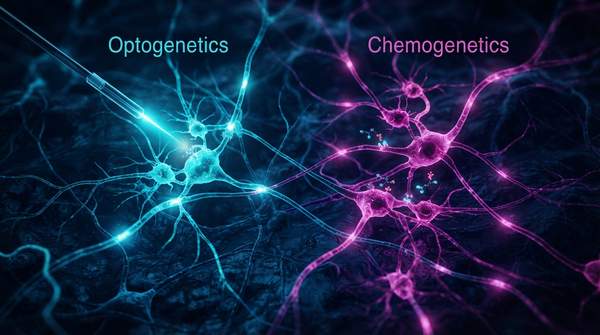
Controlling Neural Circuits: A Comparison of Optogenetics and Chemogenetics
Optogenetics and chemogenetics are powerful neuroscience tools that allow researchers to precisely control specific neurons using light or designer drugs, respectively. These techniques enable detailed study of neural circuits, brain disorders, and complex behaviors, offering distinct advantages in temporal precision versus duration of effect.

4 Emerging Neurotechnologies for Brain Health & Resilience
Despite a surge in innovation, nearly 80% of emerging neurotechnologies for brain health and resilience remain years away from FDA approval, most still in early developmental stages.

What are the cellular and molecular mechanisms driving Alzheimer's neurodegeneration?
Almost 40% of patients with clinically diagnosed mild cognitive impairment (MCI) progress to Alzheimer's dementia over an average of 18 months, according to role of amyloid-β and tau proteins in alzhe

What Are AI Models of Brain Function in Neuroscience Research?
Researchers are now mimicking biological sleep processes, like synaptic downscaling, to improve how artificial intelligence models retain concepts during learning.

What Are Advanced Neuroimaging Techniques Mapping the Human Brain?
Data downloaded directly from ConnectomeDB, the primary repository for the Human Connectome Project, now exceeds 5400 terabytes (TB).

Leading Emerging Neurotechnologies for Cognitive Enhancement
A five-day brain treatment promising an 85.

AI brain scans could diagnose aging faster, but bias and privacy loom.
A recent study showed AI could detect Alzheimer's markers five years earlier than traditional methods, yet only 3% of clinics in underserved areas have access to such technology.

What Is Working Memory and How It Powers Your Consciousness?
Imagine holding seven distinct thoughts at once.

How Memory Formation & Retrieval Works in the Brain in 2026
Neuroscientists observed tiny bursts of electrical activity, known as "brain ripples," flowing between neurons in 14 people immediately after exercise, according to the BBC .

What Are Neurotransmitters and How Do They Affect Mood?
The space between two nerve cells is less than 40 nanometers wide, yet across this microscopic gap, thousands of chemical messages are constantly firing, dictating everything from your mood to your mo

How Do Brain-Computer Interfaces Connect Minds and Machines?
Macaque monkeys are already navigating virtual reality environments using only their thoughts, revealing the profound potential of brain-computer interfaces.

University of Michigan neurosurgeons implant first wireless brain-computer interface
A person with ALS, previously unable to speak, now communicates at 56 words per minute thanks to a brain-computer interface, a rate approaching natural conversation, according to Space Daily .

How Brain-Computer Interfaces Translate Thought into Action
Brain-computer interface (BCI) technology creates a direct communication pathway between the human brain and external devices by acquiring, analyzing, and translating brain signals into commands. The field is rapidly advancing with invasive, minimally invasive, and non-invasive approaches, aiming to restore function for individuals with severe paralysis, but faces significant technical, ethical, and security challenges.

Key Neuroscience Discoveries on Consciousness and Mind
Scientists have developed an artificial receptor called mitoDreadd-Gs that can directly stimulate mitochondrial activity inside cells, offering a novel pathway to improve memory problems in animal mod