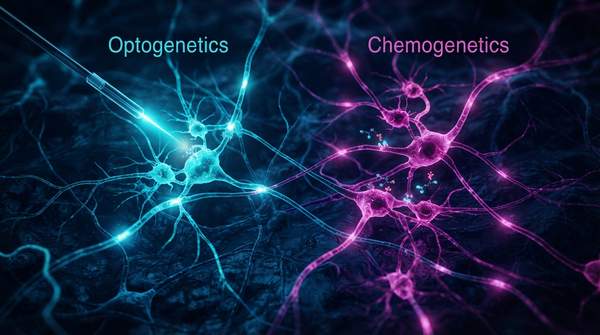
Neuroscientists are using two powerful techniques, optogenetics and chemogenetics, to gain unprecedented control over the brain's complex electrical and chemical signaling. These methods allow researchers to selectively activate or inhibit specific groups of neurons, providing a precise way to study how neural circuits influence cognition, emotion, and movement. Optogenetics uses light-sensitive proteins to control cells with light, while chemogenetics employs engineered receptors that respond only to specific designer drugs. By offering distinct advantages in speed, duration, and application, these tools are fundamentally advancing the scientific understanding of brain function and the mechanisms behind neurological disorders like depression.
The Mechanism of Optogenetics: Light-Activated Control
Optogenetics enables researchers to control the electrical activity of neurons with a high degree of temporal precision. The technique is based on a genetic modification that introduces light-sensitive ion channels, called opsins, into the membranes of targeted brain cells. According to the Synthetic Neurobiology Group, which helped pioneer these methods, these fully genetically encoded reagents allow for the control of neural activity and other high-speed physiological processes using light.
The process begins by using a genetic strategy to make a specific population of neurons express the gene for an opsin. Once these proteins are present in the cell, they can be controlled by light. To deliver this light deep within the brain, researchers typically use a permanent intracranial implant, such as a thin optical fiber. When pulses of light are sent through this fiber, the opsins are triggered to open or close. This action can either cause the neuron to fire an electrical signal, a process known as depolarization, or prevent it from firing, called hyperpolarization. This ability to turn cells on or off with such speed is a key advantage of optogenetics, allowing scientists to study the precise timing of neural events that underlie complex behaviors.
The Mechanism of Chemogenetics: Designer Drug Activation
Chemogenetics provides an alternative, less invasive method for modulating neural activity over longer periods. This technique works by modifying the specificity and affinity of cellular receptors, enabling selective control of specific cell types. The core of chemogenetics involves genetically engineering neurons to express what are known as Designer Receptors Exclusively Activated by Designer Drugs, or DREADDs. These are modified versions of G-protein-coupled receptors (GPCRs), which constitute the largest known class of receptors on the cell surface and play a critical role in cellular signaling.
Once a target group of neurons expresses these DREADDs, researchers can administer a specially designed chemical compound. This "designer drug" is engineered to be otherwise inert in the body, meaning it binds exclusively to the engineered DREADD receptors and has no effect on other cells. When the drug binds to the DREADD, it activates the receptor, which in turn can either excite or inhibit the neuron's activity. Unlike the near-instantaneous effects of optogenetics, the onset of chemogenetic activation takes minutes as the drug must diffuse through the body to reach its target. However, a single administration can modulate neuronal firing for several hours until the compound is naturally cleared, making it ideal for studying the effects of sustained changes in brain activity.
Probing Brain Disorders in Animal Models
The development of optogenetic and chemogenetic tools over the last decade has transformed research into the biological basis of brain disorders. These techniques allow scientists to move beyond simply observing correlations between brain activity and behavior. By directly manipulating specific circuits in animal models, they can establish causal links between the function of a particular set of neurons and the symptoms of a disorder. This "circuit interrogation" is crucial for understanding the underlying mechanisms of disease.
In research on depression, for example, these tools are widely used in rodent models to probe the function of brain circuits thought to be involved in mood regulation. Scientists can selectively activate or inhibit neurons in specific brain regions and observe the direct impact on behaviors that are analogous to depressive symptoms. According to a review of the field, the continued integration of optogenetic and chemogenetic tools with advanced in vivo imaging techniques will continue to advance our understanding of the circuit mechanisms of depression. This detailed mapping of the brain's functional wiring is a critical step toward identifying new targets for more effective therapies.
Optogenetics vs. Chemogenetics: A Comparative Overview
While both optogenetics and chemogenetics offer precise control over genetically targeted neurons, their different activation methods result in distinct advantages and limitations. The choice between them depends on the specific goals of a research study, particularly the need for high-speed control versus long-term, sustained modulation. The following table contrasts their core operational features.
| Feature | Optogenetics | Chemogenetics |
|---|---|---|
| Mechanism of Action | Genetically modified neurons express light-sensitive ion channels (opsins) that directly control the flow of ions. | Genetically modified neurons express engineered G-protein-coupled receptors (DREADDs) that initiate a signaling cascade. |
| Stimulus | Neuronal activity is controlled by pulses of light delivered via an implanted optical fiber. | Neuronal activity is controlled by the systemic administration of a specific, otherwise-inert designer drug. |
| Temporal Resolution | Offers precise and rapid temporal control, allowing for the activation or inhibition of neurons on a millisecond timescale. | Provides slower temporal control, with an onset that takes minutes and sustained effects that can last for several hours. |
| Invasiveness | Requires a permanent intracranial implant to deliver light pulses directly to the targeted brain region. | Does not require a permanent implant for stimulus delivery, though the initial genetic modification is still necessary. |
Choosing the Right Tool for Neural Circuit Research
The distinct profiles of optogenetics and chemogenetics make them complementary, rather than competing, tools in the neuroscience toolkit. Researchers can select the technique that best fits the question they are asking about a neural circuit, based on a clear set of trade-offs between temporal precision, duration of effect, and experimental invasiveness.
For studies that require mimicking the brain's natural, high-speed patterns of communication or investigating the immediate behavioral impact of a burst of neural firing, optogenetics is the superior choice. Its precise temporal control is essential for dissecting processes that occur on a very fast timescale. In contrast, for behavioral or therapeutic applications where sustained, long-term modulation of a circuit is more relevant, chemogenetics offers a powerful advantage. Its ability to alter neuronal activity for hours with a single drug administration is well-suited for studying the more gradual processes that may underlie mood and behavior, making it beneficial for applications where drawn-out effects are required.
Sources
- Optogenetics and Chemogenetics - PMC
- Optogenetics: molecules enabling neural control by light - Synthetic Neurobiology Group
- Frontiers | Optogenetics and chemogenetics: key tools for modulating neural circuits in rodent models of depression
- Wiring the depressed brain: optogenetic and chemogenetic circuit interrogation in animal models of depression - PMC
- Chemogenetics vs. Optogenetics: Which Method Should I Choose? — BLOG