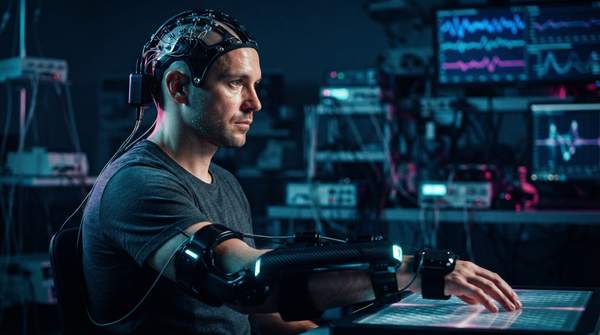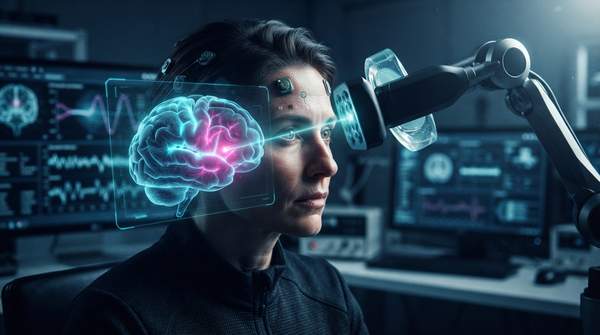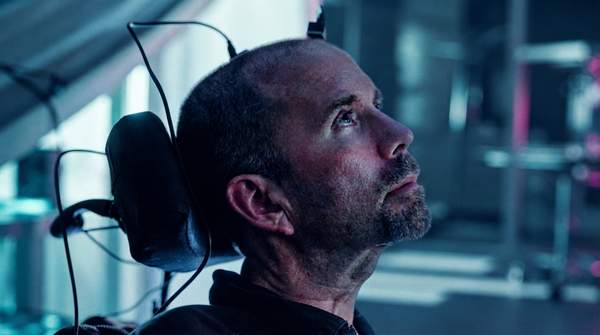
A brain-computer interface that only reads the brain is only half a system. The most promising designs for prosthetic limbs and virtual reality work as closed loops: the user's intended movement is decoded from neural signals, a device acts on it, and the resulting touch-like sensation travels back to the brain, which uses it to refine the next command. Researchers describe this as closing the sensorimotor loop, and it is the central mechanism behind more intuitive neuroprosthetics.
Understanding Closed-Loop Brain-Computer Interfaces
Conventional brain-machine interfaces let patients control computer cursors or animatronic limbs using signals recorded and decoded from their brains, an approach that may significantly improve quality of life for people who have lost motor function. But control based on brain signals alone has a built-in weakness: without sensory information, the user must rely almost entirely on vision to know what the device is doing. A review of neural prosthetics notes that research is now focused on refining decoding techniques and incorporating different forms of sensory feedback for increased control. The closed-loop concept adds the missing half of the circuit—sensation flowing back to the user—so that control becomes a continuous conversation rather than a one-way command.
Decoding Motor Intent: Brain Signal Acquisition and Processing
Every cycle of the loop begins with acquisition. Electrodes record the user's brain activity—commonly via electroencephalography, or EEG, in non-invasive systems—while the user produces a signal that encodes an intended movement. That raw signal is then decoded and processed: algorithms detect the characteristic patterns associated with the intent, filter noise, and translate the modulated signal into a form a machine can act on. The decoding stage is where the choice of signal paradigm matters most, because different brain responses offer different trade-offs between how much training the user needs and how naturally the signal maps onto movement.
Controlling Devices: From Thought to Action
Once decoded, the signal becomes a control command. In a prosthetic context, the command might drive a limb's grasp; in virtual reality, it might move an avatar's hand. The survey by Mathis Fleury and colleagues at Inria and the University of Rennes, published in Frontiers in Neuroscience in 2020, describes how a modulated brain signal can be employed to control haptic interfaces directly. The device executes the task the user's brain activity specifies, and this is the point at which the loop would end in an open-loop system. What distinguishes a closed-loop design is that the action itself becomes the trigger for the next stage: generating sensation.