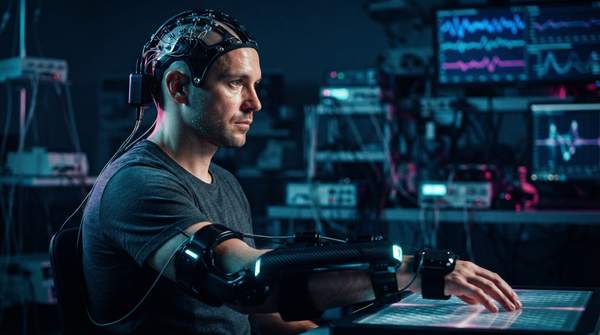
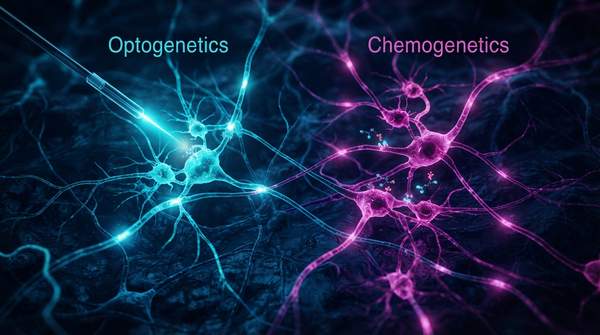
Key Neuroscience Discoveries on Consciousness and Mind

Scientists have developed an artificial receptor called mitoDreadd-Gs that can directly stimulate mitochondrial activity inside cells, offering a novel pathway to improve memory problems in animal mod

JC
Juliana Campos

May 19, 2026 · 6 min read

Abstract visualization of a human brain's neural network, highlighting glowing mitochondria as the source of energy for consciousness and thought processes.

Scientists have developed an artificial receptor called mitoDreadd-Gs that can directly stimulate mitochondrial activity inside cells, offering a novel pathway to improve memory problems in animal models of neurodegenerative disease, according to ScienceDaily. Targeted cellular intervention could transform how researchers approach cognitive decline, providing hope for millions facing cognitive impairment.

Our understanding of consciousness is expanding through complex neuroimaging and philosophical mapping, but the most impactful discoveries are pointing to basic cellular machinery, like mitochondria, as direct drivers of cognitive symptoms.

Future treatments for cognitive decline and a deeper understanding of consciousness itself will increasingly focus on manipulating fundamental biological processes at the cellular level, shifting paradigms from purely neurological to integrated cellular-neurological approaches.

Modern neuroimaging methods have had a transformative impact on consciousness science, allowing for detailed observation of brain activity, according to PMC. Yet, researchers have also established a direct cause-and-effect link between faulty mitochondrial activity and cognitive symptoms associated with neurodegenerative disease, as reported by ScienceDaily. This suggests that the failure of mitochondria may drive the symptoms that appear as dementia develops, rather than simply breaking down after brain disease begins. These advanced tools and cellular insights are fundamentally reshaping our understanding of consciousness and cognitive health, revealing deep biological underpinnings.

1. Split-Brain Studies by Sperry and Gazzaniga

Best for: Understanding hemispheric specialization of consciousness.

In the 1960s, studies by Sperry and Gazzaniga revealed that each cerebral hemisphere could perceive a visual stimulus independently, according to PMC. The work fundamentally changed the understanding of independent conscious processing.

Strengths: Provided foundational insights into brain lateralization. | Limitations: Focused on extreme cases of brain surgery. | Price: N/A (historical research)
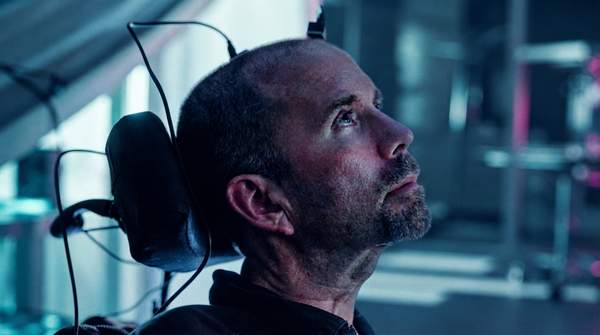
2. New Understanding of Consciousness in Vegetative States

Best for: Re-evaluating patient awareness and care protocols.

New research suggests that patients in a vegetative state may possess a higher level of awareness than previously understood, as reported by The New York Times. The discovery profoundly alters the understanding of awareness in a critical clinical context.

Strengths: Alters clinical and ethical frameworks for patient care. | Limitations: Requires advanced neuroimaging for detection. | Price: N/A (ongoing research)

3. Cause-and-Effect Link Between Faulty Mitochondrial Activity and Cognitive Symptoms

Best for: Identifying fundamental biological mechanisms of cognitive decline.

Researchers established a cause-and-effect link between faulty mitochondrial activity and cognitive symptoms associated with neurodegenerative disease, according to ScienceDaily. The discovery shifts understanding of the origins of neurodegenerative diseases.

Strengths: Pinpoints a direct biological mechanism. | Limitations: Primarily observed in animal models currently. | Price: N/A (basic research)

4. Mitochondrial Failure as a Primary Driver of Dementia Symptoms

Best for: Reorienting research into dementia etiology.

The failure of mitochondria may drive the symptoms that appear as dementia develops, rather than simply breaking down after brain disease begins, states ScienceDaily. The failure of mitochondria offers a new etiological understanding of dementia.

Strengths: Challenges existing views on disease progression. | Limitations: Requires further human validation. | Price: N/A (conceptual shift)

5. Improvements in Memory by Increasing Mitochondrial Activity

Best for: Developing targeted therapies for memory impairment.

Temporarily increasing mitochondrial activity in animal models of neurodegenerative disease led to improvements in memory problems, according to ScienceDaily. The improvements demonstrate a direct link between mitochondrial function and cognitive performance.

Strengths: Shows direct, actionable therapeutic potential. | Limitations: Results are currently in animal models. | Price: N/A (pre-clinical)

6. Restoring Mitochondrial Function as a Strategy for Dementia Treatment

Best for: Guiding new therapeutic development for neurodegenerative diseases.

Restoring mitochondrial function may become a strategy for slowing or reducing symptoms of dementia, as reported by ScienceDaily. Restoring mitochondrial function represents a new understanding of potential interventions to mitigate cognitive decline.

Strengths: Offers a novel, fundamental approach to treatment. | Limitations: Clinical trials in humans are pending. | Price: N/A (future therapy)

7. Transformative Impact of Modern Neuroimaging Methods

Best for: Advancing non-invasive observation of brain activity.

Modern neuroimaging methods have had a transformative impact on consciousness science, according to PMC. Modern neuroimaging methods enable crucial observations of brain function without invasive procedures.

Strengths: Provides detailed, real-time brain insights. | Limitations: Primarily observational, not directly interventional. | Price: N/A (technology category)

8. Conceptual Shift: Progress in Consciousness Science Depends on Mapping First-Person to Third-Person Descriptions

Best for: Defining the scientific approach to understanding consciousness.

Progress in consciousness science depends on specifying closer explanatory mappings between first-person phenomenological descriptions and third-person objective descriptions of neuronal mechanisms, states PMC. The conceptual shift outlines a key scientific approach to bridge subjective experience with objective neural processes.

Strengths: Provides a clear framework for research. | Limitations: Methodological challenges in execution. | Price: N/A (theoretical framework)

9. Ethical Implications of Understanding Consciousness in Vegetative Patients

Best for: Informing societal and individual decision-making regarding end-of-life care.

This emerging understanding of consciousness in vegetative patients presents families with difficult choices, as reported by The New York Times. The emerging understanding highlights the profound societal and personal impact of new scientific discoveries.

Strengths: Addresses real-world human impact of research. | Limitations: Creates complex moral dilemmas. | Price: N/A (societal impact)

Discovery FocusMethodologyKey InsightTherapeutic Potential (for cognitive decline)
Consciousness & Brain FunctionSurgical Observation & Behavioral TestsEach cerebral hemisphere can perceive stimuli independently.Indirect, by understanding functional localization.
Cellular Basis of CognitionGenetic Manipulation & Animal ModelsFaulty mitochondrial activity directly causes cognitive symptoms.Direct, by restoring mitochondrial function.
Awareness in Vegetative StatesAdvanced Neuroimaging & Clinical AssessmentPatients may possess higher awareness than previously understood.Indirect, by informing care and communication strategies.

The Science of Unraveling the Mind

Progress in consciousness science depends on specifying closer explanatory mappings between first-person phenomenological descriptions and third-person objective descriptions of neuronal mechanisms, states PMC. The conceptual framework guides researchers in bridging subjective experience with measurable brain activity, providing a roadmap for future investigations into the mind.

The therapeutic potential of this research is tangible: restoring mitochondrial function may become a strategy for slowing or reducing symptoms of dementia, according to ScienceDaily. The direct cellular intervention offers a promising new direction for treatment development, moving beyond broader neurological targets.

However, the emerging understanding of consciousness in vegetative patients presents families with difficult choices, as reported by The New York Times. Scientific advancements, while profound, introduce complex ethical considerations into patient care. Bridging subjective experience with objective biological data is the ongoing challenge, leading to both profound scientific understanding and complex ethical considerations.

Pharmaceutical companies clinging to broad neurological targets for cognitive decline are missing the opportunity to develop highly specific, cellular-level interventions that could offer more effective treatments. This is based on ScienceDaily's findings.dings that increasing mitochondrial activity directly improves memory problems and the development of artificial receptors like mitoDreadd-Gs.

The ScienceDaily revelation that mitochondrial failure actively drives dementia symptoms, rather than merely being a secondary breakdown, demands a radical re-evaluation of current research paradigms. Many existing treatments might be addressing symptoms rather than root causes, suggesting a need for a fundamental shift in therapeutic development.

This shift away from purely high-level neurological approaches toward integrated cellular-neurological strategies indicates a new frontier in cognitive health. By 2026, pharmaceutical giant BioGenX could announce new research initiatives focused on mitochondrial therapies, potentially reshaping their dementia drug pipeline.

What are the latest breakthroughs in understanding consciousness?

Recent breakthroughs extend beyond cellular mechanisms to include advanced studies into specific brain oscillation patterns, such as gamma waves, which are increasingly correlated with conscious awareness. Researchers are also developing more precise biomarkers using magnetoencephalography (MEG) to differentiate various states of consciousness, including minimal consciousness and wakefulness, in clinical settings.

How has neuroscience changed our view of the mind?

Neuroscience has moved beyond viewing the mind as a product of isolated brain regions, instead emphasizing it as an emergent property of dynamic, distributed neural networks. This perspective highlights the crucial role of connectivity and synchronized activity across the entire brain, rather than just localized functions, in creating subjective experience.

What is the future of consciousness research?

The future of consciousness research involves developing personalized medicine approaches that factor in individual mitochondrial health profiles for cognitive therapies. It also includes the integration of artificial intelligence and machine learning to analyze vast neuroimaging data, aiming to create predictive models for consciousness states and cognitive decline, and exploring novel non-invasive brain stimulation techniques like transcranial magnetic stimulation (TMS) for both therapeutic and investigative purposes.