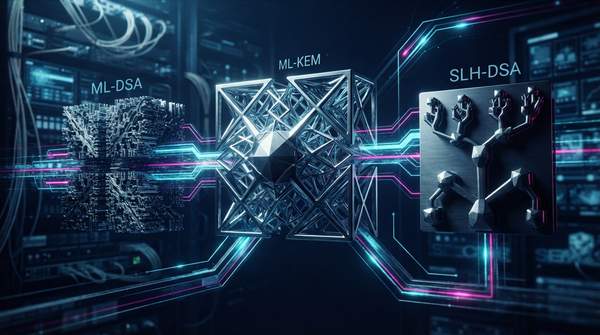
Enterprises planning a quantum-resistant future have three finalized federal standards to choose from, and the choice is not one algorithm versus another but a division of labor. In August 2024, NIST finalized FIPS 203 (ML-KEM) for key establishment and FIPS 204 (ML-DSA) and FIPS 205 (SLH-DSA) for digital signatures. The first two rest on lattice mathematics; the third on hash functions. That single distinction drives most of the practical trade-offs in performance, design complexity, and long-term security assumptions that security architects must weigh.
The Quantum Threat and NIST's PQC Standards
The urgency behind post-quantum cryptography comes from a specific vulnerability: classical public-key systems such as RSA and elliptic-curve cryptography can be broken by Shor's algorithm running on a large-scale quantum computer, as Palo Alto Networks' technical guide explains. NIST's PQC project, which released the first three finalized standards in 2024, aims to replace those foundations with mathematical problems believed hard for both classical and quantum attackers. Importantly, the new algorithms run on ordinary classical hardware — no quantum computer is required to deploy them.
What makes the transition pressing is not the arrival of a cryptographically relevant quantum computer but the behavior of adversaries before it arrives. A Cloud Security Alliance Lab analysis notes that less than two years after the August 2024 standards release, enterprise deployment stood at roughly 5%, a gap it calls striking given the underlying risk. The standards themselves, however, are ready: NIST finalized them after an eight-year international standardization process, and they are now the reference point for vendor products and compliance reviews.
NIST's Finalized PQC Algorithms: ML-KEM, ML-DSA, and SLH-DSA
The three standards divide cleanly by function. ML-KEM, derived from the CRYSTALS-Kyber submission, became the main standard for creating shared secrets between systems — the key-establishment role that key exchange protocols depend on. ML-DSA, derived from CRYSTALS-Dilithium, became a key standard for digital signatures, and SLH-DSA, derived from SPHINCS+, became another approved signature method, as AT&T's enterprise guidance summarizes.
CISA's reference table of NIST-standard PQC algorithms confirms the mapping: ML-KEM under FIPS 203 for key establishment, ML-DSA under FIPS 204 and SLH-DSA under FIPS 205 for signatures. CISA also lists stateful hash-based signature schemes (LMS, HMS, XMSS, XMSSMT) under NIST SP 800-208, but those are separate standards outside this comparison. Notably, NIST also selected Hamming Quasi-Cyclic (HQC) in 2025 for future standardization as another key-establishment algorithm — a reminder that the algorithm landscape is still evolving, which AT&T frames as reinforcing the need for crypto agility, the ability to change algorithms without a full rebuild.
Mathematical Foundations: Lattice-Based vs. Hash-Based Cryptography
Classical public-key cryptography rests on factoring and discrete logarithms; post-quantum cryptography shifts to problems believed hard for quantum computers as well. Within the three finalized standards, two families matter. ML-KEM and ML-DSA are lattice-based: their security rests on problems involving high-dimensional mathematical grids, conceptually akin to finding the shortest vector in a high-dimensional lattice, as Palo Alto Networks describes. This family has proven versatile — the same underlying mathematics supports both key establishment and signatures, which is why it supplies both ML-KEM and ML-DSA.
SLH-DSA is hash-based instead. Its security derives from the properties of hash functions rather than lattice problems, and its design is stateless — each signature can be generated independently without tracking usage state, which simplifies implementation and eliminates a class of misuse risks that affect stateful hash-based schemes. The trade-off is scope: hash-based cryptography in the NIST portfolio applies only to signatures, not key establishment. An enterprise therefore cannot choose "hash-based" for key exchange; that role belongs to ML-KEM today.
Comparative Overview of NIST-Finalized PQC Standards
The table below consolidates the standards' core attributes. Reading it by column reveals the central decision structure: first pick the cryptographic function (key establishment versus signature), then pick the mathematical family that fits your risk profile and performance constraints.
| Standard | Algorithm | Primary Use Case | Mathematical Foundation | Key Characteristics & Trade-offs |
|---|---|---|---|---|
| FIPS 203 | ML-KEM (from CRYSTALS-Kyber) | Key establishment / encapsulation of shared secrets | Structured lattices | Main standard for shared secrets; lattice-based; larger handshake payloads than classical key exchange |
| FIPS 204 | ML-DSA (from CRYSTALS-Dilithium) | Digital signatures | Structured lattices | Key signature standard; same lattice family as ML-KEM, easing combined adoption |
| FIPS 205 | SLH-DSA (from SPHINCS+) | Digital signatures | Hash functions | Stateless design simplifies implementation; security rests on hash-function assumptions rather than lattice problems |
The comparison yields a clear division of labor: ML-KEM is the only finalized option for key establishment, so every enterprise migration uses it for that function. For signatures, the choice between ML-DSA and SLH-DSA is genuinely open — it hinges on whether an organization prefers the lattice assumptions shared with ML-KEM or the comparatively conservative, hash-based security posture of SLH-DSA, balanced against performance characteristics in its specific environment.
Practical Implications for Enterprise Security
The most concrete implementation cost is size. PQShield's guidance notes that some post-quantum algorithms require larger keys or more computation than classical alternatives, affecting performance, latency, and memory usage, particularly in constrained environments. A peer-reviewed analysis quantifies the network effect: a hybrid TLS 1.3 handshake combining X25519 with ML-KEM-768 and ECDSA with ML-DSA-65 may exceed 15 KB, compared with roughly 4 KB for classical-only handshakes, per IETF draft measurements. That roughly fourfold increase touches every protocol that carries cryptographic payloads.
For planning purposes, the practical consequences are protocol-level: TLS handshakes, VPNs, and certificate chains all grow, and constrained devices feel the memory and computation burden most. The lattice pair (ML-KEM, ML-DSA) offers operational coherence — one mathematical family, one vendor ecosystem, shared implementation libraries — while SLH-DSA's stateless design reduces the risk of implementation errors that plague stateful signature schemes. Neither choice is universally superior; the right answer depends on where signatures are used and how much overhead each environment tolerates.
Enterprise Migration Strategies: Addressing the 'Harvest Now, Decrypt Later' Threat
The reason to act before quantum computers arrive is the "Harvest Now, Decrypt Later" strategy. As Palo Alto Networks explains, adversaries are currently intercepting and storing encrypted communications, gambling on the "Q-Day" timeline — the moment a quantum computer can break standard encryption. Data that must remain confidential for 10, 15, or 20 years is, in this threat model, already vulnerable to future decryption. The Cloud Security Alliance analysis makes the same point: adversaries need not wait for Q-Day to start collecting.
Hybrid approaches are the recommended interim measure. PQShield describes hybrid cryptographic schemes that combine classical and post-quantum algorithms during transition periods, providing protection against both traditional and quantum attack while maintaining compatibility — the same posture Fortinet summarizes as running classical and post-quantum encryption in parallel. PQShield also advises folding PQC into broader cybersecurity risk management rather than treating it as a standalone project, and AT&T recommends starting with a cryptographic inventory, since cryptography questions are increasingly appearing in audits, vendor reviews, and technology planning.
Preparing for Quantum Resilience: A Call to Action
Enterprises must initiate or accelerate their post-quantum cryptography migration strategies, prioritizing the adoption of NIST-finalized standards and implementing hybrid cryptographic approaches to mitigate the "Harvest Now, Decrypt Later" threat. The decision framework is straightforward: ML-KEM for key establishment, a signature choice between ML-DSA and SLH-DSA based on mathematical-family preference and performance constraints, hybrid schemes during transition, and a cryptographic inventory as the starting point.
The observable signal to watch is the increasing availability and adoption of PQC-capable products in enterprise security categories, as well as the ongoing updates to NIST's PQC standardization efforts — including the HQC selection in 2025, which confirmed that the standards landscape continues to move. Organizations should track when their vendors ship FIPS 203, 204, and 205 support and when hybrid key exchange appears in their TLS stacks; those milestones, not speculative Q-Day predictions, are the measurable markers of readiness.
Sources
- What Is Post-Quantum Cryptography? — NIST
- What Is Post-Quantum Cryptography (PQC)? A Complete Guide — Palo Alto Networks
- Q-Day Clock: Enterprise Post-Quantum Migration Imperative — Lab Space
- Post quantum cryptography (PQC) explained — AT&T Business
- Product Categories for Technologies That Use Post-Quantum Cryptography Standards — Cybersecurity and Infrastructure Security Agency CISA
- Post Quantum Cryptography & Quantum Resilience — PQShield
- What Is Post-Quantum Cryptography (PQC)? A Quantum-Resistant Guide — Fortinet