CRISPR-Cas9 is famous as a pair of molecular scissors that cuts DNA to edit genes, but some of its most versatile uses require no cutting at all. By disabling the cutting function or swapping in entirely different enzymes, researchers have turned the CRISPR concept into a toolkit for switching genes on and off, rewriting epigenetic marks, and detecting viruses and mutations in minutes. The key to telling these applications apart is simple: look at the enzyme, the target molecule, and the intended outcome.
The Programmable Platform: How dCas9 Enables New Functions
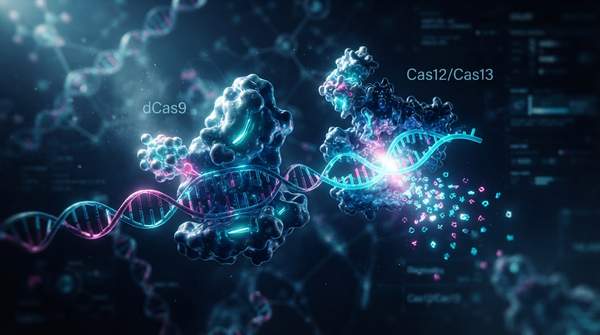
The foundation of most non-editing CRISPR applications is a modified protein called dCas9: a catalytically inactive form of Cas9. Standard Cas9 works by using a guide RNA to find a matching DNA sequence and then cutting both strands of the DNA double helix. Researchers disable this cutting ability, and what remains is a protein that still binds DNA with remarkable precision but does nothing once it arrives. In effect, the scissors become a programmable address label.
That address-label function is what makes dCas9 a platform rather than a single tool. As a review of CRISPR applications across various fields explains, researchers have harnessed the technology for purposes beyond gene knockout, including gene activation and repression. In a study by Gilbert and colleagues, the dCas9 protein was fused to transcriptional activators or repressors, enabling precise control of gene expression. The critical design move is that whatever other protein is attached to dCas9 gets delivered to the exact genomic address the guide RNA specifies.
This fusion strategy turns the question "what does CRISPR do?" into "what did you bolt onto it?" An activator domain fused to dCas9 turns a gene up; a repressor domain turns it down; other cargoes can image DNA or chemically modify it. The system's precision comes from the guide RNA, which dictates exactly where the fused payload goes, while the inactivated nuclease ensures the DNA itself is never severed. A separate review of CRISPR applications beyond gene editing notes that dCas9-based epigenomic editing is expected to prove invaluable for singling out disease-causing epigenetic changes from indirect effects, opening doors to new treatment options and a better understanding of human pathogenesis.
CRISPR for Gene Regulation and Epigenome Editing
The most direct use of dCas9 is controlling gene expression without altering the DNA sequence at all. In these systems, often called CRISPRa (activation) and CRISPRi (interference or repression), the guide RNA directs dCas9 to a gene's regulatory region, typically the promoter. The effector domain fused to dCas9 then either recruits the cellular machinery needed to transcribe the gene or blocks that machinery from accessing it. The gene itself remains intact; only its activity level changes.
Epigenome editing takes the same logic one step further. Rather than blocking or boosting transcription directly, dCas9 can be fused to enzymes that add or remove chemical marks on DNA or on the histone proteins around which DNA is wrapped. These marks—collectively the epigenome—determine how accessible a stretch of DNA is and therefore how strongly nearby genes are expressed. Because epigenome-wide association studies are generating hundreds and thousands of epigenomic markers associated with human disease, as the review of CRISPR applications beyond gene editing observes, having a tool that can rewrite a specific mark at a specific locus lets researchers test which change actually drives disease rather than merely accompanying it.
The common thread across both uses is that the outcome depends entirely on the specific effector domain fused to dCas9. The targeting half of the system—the guide RNA and the dead nuclease—stays constant. This modular architecture is what allows a single platform to serve as a volume dial, an imaging tag, or a chemical paintbrush, all without touching the underlying genetic code.