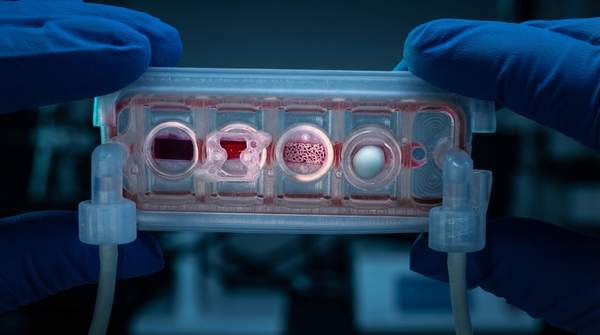
Organ-on-a-chip technology compresses the essential architecture of a human organ onto a device smaller than a thumb drive, and it is doing so at a moment when the traditional drug development pipeline is demonstrably failing: the FDA reports that over 90% of drugs that prove safe in animals fail in humans. These microfluidic platforms culture living human cells in a three-dimensional, mechanically and biochemically active environment designed to reproduce the physiology of a specific organ, according to a definition cited by the National Toxicology Program's evaluation center for alternative toxicological methods. The result is a testbed that is more physiologically relevant than animal models or laboratory cultures, and one that can be built from a single patient's own cells for personalized drug screening.
Understanding Organ-on-a-Chip Technology: Core Components
The concept traces back roughly three decades to early applications of microfluidic devices for cell culture and biological analysis. A scientific review published in the journal Pharmaceutics explains that, unlike tissue engineering, the approach does not try to reproduce whole organs at full scale for clinical transplantation. Instead, it mimics key organotypic cellular architecture and functionality, the 3D extracellular matrix, biochemical factors, and biophysical cues at a smaller scale, serving the purposes of disease modeling and drug screening.
Three components work together to make this possible. The first is the microfluidic architecture: micro-scale channels that carry nutrients and candidate drugs to the cells, creating a dynamic, flowing environment that static laboratory dishes cannot match. The second is the cell culture itself—living human cells, sometimes derived from individual patients, arranged in three dimensions rather than flattened on plastic. The third is mechanical force: the platforms subject tissues to physical cues present in living organs, such as the stretching and compression that cells experience in the body.
Together these elements allow researchers to observe and manipulate human tissue function directly. A review of the field describes how a multi-organ "human-on-a-chip" platform containing a functional human immune component was used to evaluate tissue-specific immune responses in cardiac, skeletal, and hepatic compartments to amiodarone, an anti-arrhythmic drug—illustrating how the systems can assess how a given drug behaves across different tissues.