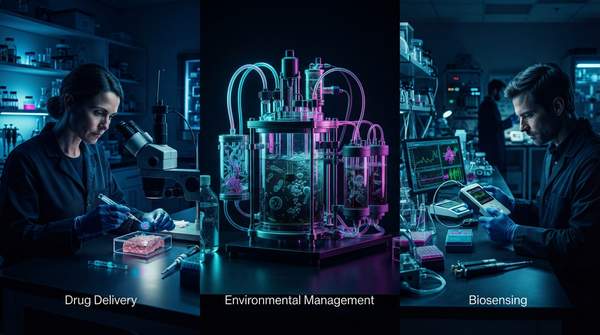
Synthetic biology is not one technology applied to many fields—it is one engineering discipline producing three very different strategies. In medicine, researchers engineer cells and cell-derived nanomaterials to deliver drugs precisely inside the body. In environmental management, engineered microbes convert biomass into fuels or break down pollutants. In diagnostics, cell-free biosensors take measurements in real water samples in the field. What unites them is a shared methodology: the iterative Design, Build, Test, Learn cycle. What separates them is the goal each field is engineering toward, and the biological system chosen to reach it.
Introduction: Engineering Life for Diverse Solutions
Synthetic biology, as Pelinsu Karataş and Furkan Ayaz describe in a review in Discover Biotechnology, is the process of designing and creating biological systems and organisms using engineering principles, with the primary goal of building advanced biological systems that produce beneficial products. The field designs standardized bioparts and biocomponents to generate useful biofeatures, drawing on DNA synthesis, sequencing, and mathematical modeling. Its practical applications have only become possible in the past two decades, as advances in genomic and metabolic engineering tools matured. Those same tools now serve goals as different as tumor treatment, waste purification, and water-quality testing.