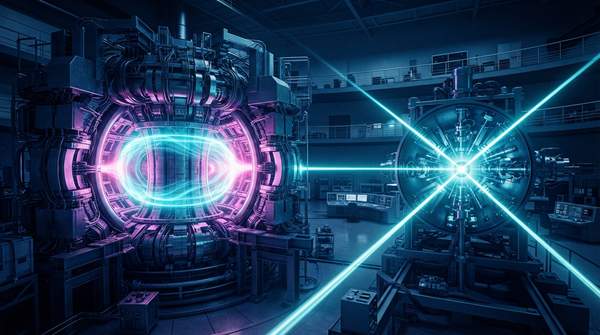
The pursuit of nuclear fusion, the process that powers the sun, hinges on two primary strategies for taming star-like conditions on Earth: magnetic confinement and inertial confinement. While both aim to generate clean, abundant energy, they represent fundamentally different engineering philosophies. One approach seeks to contain a relatively thin, superheated gas for long durations using powerful magnetic fields, while the other uses immense, instantaneous force to crush a tiny fuel pellet to extreme densities.
These two paths, known as Magnetic Confinement Fusion (MCF) and Inertial Confinement Fusion (ICF), are guided by the same core physics principle. To achieve a self-sustaining fusion reaction, a fuel source must reach a critical combination of temperature, density, and confinement time. This benchmark, known as the Lawson criterion or "triple product," dictates the design of every fusion experiment. The choice to prioritize a long confinement time or an incredibly high density leads to vastly different machines and a unique set of monumental engineering challenges for each approach.
The Lawson Criterion: A Universal Recipe for Fusion
For fusion to occur, atomic nuclei—typically forms of hydrogen called deuterium and tritium—must be forced close enough to overcome their natural electrical repulsion and merge, releasing enormous amounts of energy. This requires creating a state of matter called plasma at temperatures many times hotter than the sun's core. The Lawson criterion defines the minimum conditions for this to happen efficiently.
The "triple product" is a measure of three key variables: the density of the plasma particles, the plasma's temperature, and the duration for which it can be confined, or "confinement time." According to an analysis of fusion reactor data, achieving a high enough triple product is the central goal. Magnetic and inertial confinement represent two distinct strategies for satisfying this equation. MCF focuses on maximizing the confinement time for a low-density plasma, while ICF aims to achieve an extraordinarily high density for an infinitesimally short time.
Magnetic vs. Inertial Confinement Fusion: A Comparative Overview
The different strategies for satisfying the triple product result in fundamentally distinct technologies, each with its own set of trade-offs and engineering hurdles. The following table outlines the core differences between the two leading approaches to achieving fusion energy.
| Feature | Magnetic Confinement Fusion (MCF) | Inertial Confinement Fusion (ICF) |
|---|---|---|
| Confinement Method | Uses powerful magnetic fields to contain hot, charged plasma within a defined space, preventing it from touching the reactor walls. | Uses high-energy lasers or particle beams to rapidly compress and heat a small fuel pellet, causing it to fuse before it can expand. |
| Plasma Density | Operates with a relatively low-density plasma. | Achieves extremely high plasma densities during the brief moment of compression. |
| Confinement Time | Aims for long confinement durations to allow fusion reactions to occur continuously or in long pulses. | Relies on extremely short confinement times, on the order of nanoseconds (billionths of a second). |
| Primary Engineering Challenge | Maintaining plasma stability over long periods and managing the intense heat exhaust from the reaction. | Achieving sustained, repetitive fusion reactions and improving the overall energy efficiency of the system. |
| Key Example Project | ITER (International Thermonuclear Experimental Reactor), a tokamak design. | NIF (National Ignition Facility) at Lawrence Livermore National Laboratory. |
Magnetic Confinement: The Long-Duration Approach
Magnetic confinement fusion operates on the principle of holding a diffuse plasma at extreme temperatures for extended periods. The most common MCF device is the tokamak, a donut-shaped reactor that uses a complex array of powerful magnets to create a "magnetic bottle" for the plasma. Because the plasma is less dense, it must be held stable for a longer time to provide enough opportunities for the nuclei to fuse.
This long-duration strategy has been a primary focus of fusion research since the 1950s, leading to a deep understanding of its operational challenges, according to a review in World Scholars Review. The main hurdle for MCF is achieving sustained plasma stability. Any instabilities can cause the plasma to escape its magnetic confinement, which halts the reaction and can damage the reactor walls. Another critical challenge is managing the intense heat and particle exhaust, which must be safely vented without compromising the machine's integrity. Projects like ITER represent a global effort to solve these complex engineering problems at scale.
Inertial Confinement: The High-Impact Approach
Inertial confinement fusion takes the opposite approach: brute force over a minuscule timeframe. As demonstrated at the U.S. National Ignition Facility (NIF), ICF works by firing an array of incredibly powerful lasers at a tiny pellet of fusion fuel, often just a few millimeters in diameter. In a few billionths of a second, these lasers deliver a massive pulse of energy, compressing the fuel to densities far greater than the center of the sun. The fusion reaction must happen in the instant before the pellet's own outward pressure causes it to fly apart—its inertia provides the only confinement.
This method has been responsible for recent scientific breakthroughs. An analysis of reactor data found that NIF has achieved the highest triple product to date, driven by its ability to create exceptionally high plasma density. However, ICF faces its own daunting engineering challenges. For a power plant to be viable, it would need to ignite fuel pellets many times per second with perfect precision, a task the Kleinman Center for Energy Policy describes as a "dizzying engineering challenge." The issue of achieving sustained fusion reactions, rather than single successful shots, remains a significant hindrance to its commercial application.
Beyond Physics: Hurdles on the Path to Commercial Fusion
Even after scientists master plasma physics, significant practical barriers must be overcome before fusion can power the grid. A primary concern across both approaches is materials science. According to the World Nuclear Association, the neutrons produced by fusion are much more energetic than those from nuclear fission (14.1 MeV compared to about 2 MeV), posing "significant challenges regarding structural materials" that must endure this bombardment for years without degrading.
Furthermore, achieving a net-positive energy output on a sustained basis is the ultimate challenge for both magnetic and inertial confinement designs. While experiments have demonstrated fusion ignition, where a reaction produces more energy than the fuel absorbed, no facility has yet achieved this at a frequency and scale needed for continuous power generation. Overcoming these material and operational hurdles is essential for transforming fusion from a scientific marvel into a practical energy source.
Understanding the Path to Commercial Fusion
Readers should understand that while both magnetic and inertial confinement fusion have demonstrated significant scientific progress, they represent fundamentally different engineering pathways to achieving sustained, net-positive energy, each with distinct challenges that require ongoing research and development. The choice between a long-duration, low-density plasma held by magnets and a high-density, short-burst reaction driven by lasers is a strategic trade-off aimed at solving the same fundamental physics equation.
Progress toward a commercial fusion reactor depends on solving the unique problems inherent to each path. For magnetic confinement, the key is mastering plasma stability and heat management for continuous operation. For inertial confinement, the challenge lies in developing systems that can repeatedly and efficiently ignite fuel pellets at a high rate. The ultimate success of either approach will be measured by its ability to move beyond single experimental achievements to reliable, sustained energy production.
Sources
- NUCLEAR FUSION — IEJSE
- The Current State of Nuclear Fusion Research: A Review and Assessment of Leading Technologies — WSReview
- Bringing Fusion Energy to the Grid: Challenges and Pathways — Kleinman Center for Energy Policy
- Nuclear Fusion Power - World Nuclear Association