
Daron Krikorian
Editorial byline
Daron Krikorian is an editorial byline for New Frontier Magazine, with a focus on Space Exploration, Explainers. Biographical credentials and external profiles are published only after verification.
Learn more about our editorial process and use of automation in our AI & Automation disclosure.
Coverage Areas
Latest Articles
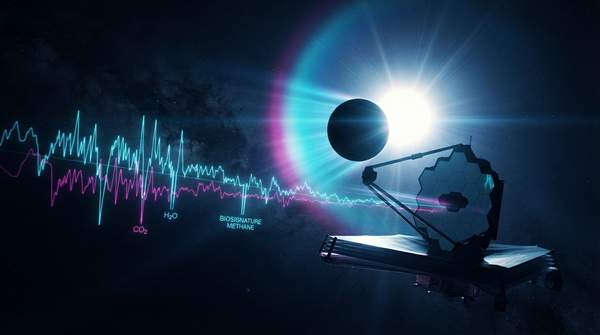
How JWST Reads Exoplanet Air: Transmission Spectroscopy and the Hunt for Biosignature Gases
The James Webb Space Telescope analyzes exoplanet atmospheres using transmission spectroscopy, detecting molecules by observing how starlight filters through an atmosphere during a transit. While powerful for identifying potential biosignature gases like methane or dimethyl sulfide, confirmation requires ruling out non-biological origins.
Oct 19, 2026 · 5 min read
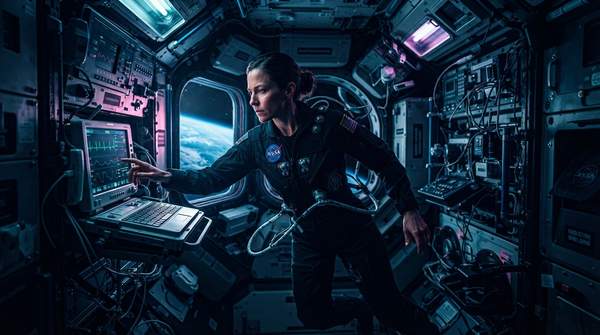
Three Fronts in the Fight for Astronaut Health: Gravity, Radiation, and the Closed Cabin
Long-duration spaceflight poses three primary threats to astronaut health: altered gravity, space radiation, and the hostile, closed spacecraft environment. Each requires distinct countermeasures to ensure mission success and crew well-being.
Oct 19, 2026 · 4 min read
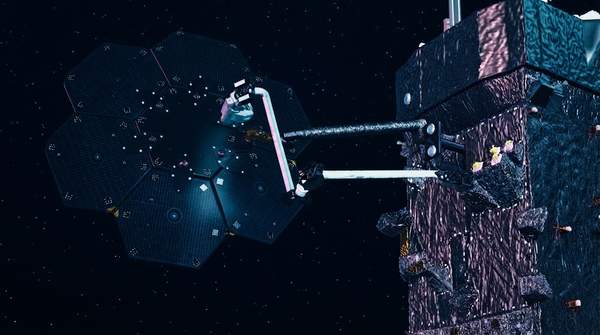
Why Robots Must Build in Orbit: The Three Technologies Behind Autonomous In-Space Manufacturing
Autonomous in-space manufacturing relies on three interdependent technologies: robotic systems for manipulation, autonomous control for independent operation, and specialized materials. These capabilities are crucial for overcoming the physical constraint of rocket payload size, enabling the construction of larger structures in orbit.
Oct 16, 2026 · 5 min read
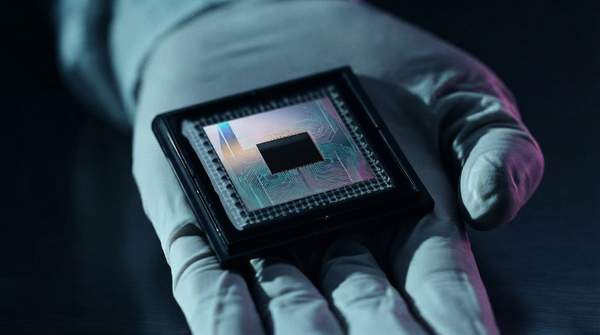
How the CNOT Gate Turns Qubits Into Entangled Pairs
Multi-qubit gates, like the CNOT gate, are fundamental to quantum computing for creating entanglement, where qubit states are correlated and cannot be described independently. The CNOT gate's conditional operation, flipping a target qubit only if the control qubit is in the |1⟩ state, is the key mechanism for generating these entangled states, such as Bell and GHZ states.
Oct 16, 2026 · 5 min read
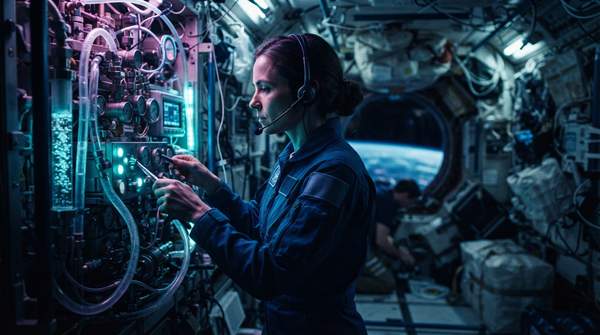
How the Space Station Turns Exhaled Breath Back into Oxygen
Long-duration space missions require closed-loop life support systems to recycle waste into essentials. The International Space Station's Advanced Closed Loop System (ACLS) demonstrates this by converting exhaled carbon dioxide back into breathable oxygen through a multi-stage process.
Oct 11, 2026 · 4 min read
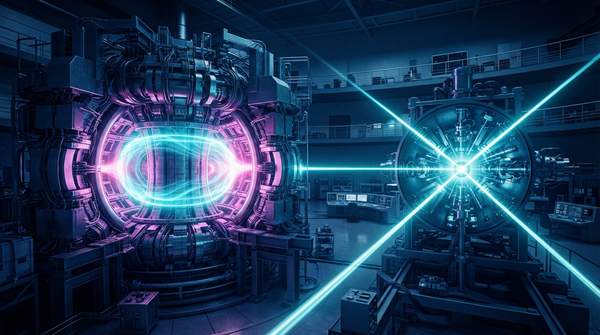
How Magnetic and Inertial Confinement Shape the Quest for Fusion Power
Nuclear fusion research explores two primary strategies: magnetic confinement (MCF) and inertial confinement (ICF). Both aim to achieve the Lawson criterion for sustained fusion reactions, but employ vastly different methods of plasma density and confinement time.
Oct 10, 2026 · 4 min read
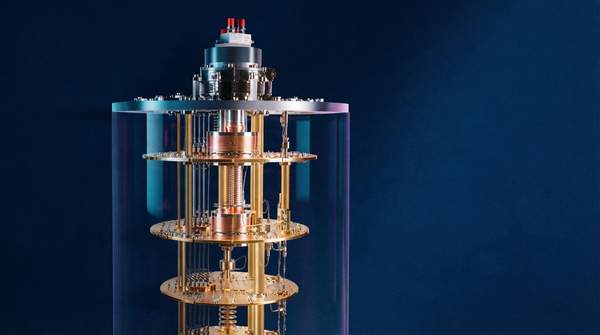
Two Paths to Quantum Fault Tolerance: Comparing Trapped-Ion and Neutral-Atom Architectures
Building fault-tolerant quantum computers requires overcoming qubit fragility through complex architectures. This article compares two leading approaches: trapped-ion and neutral-atom, detailing their distinct strategies for scaling and error correction.
Oct 6, 2026 · 4 min read
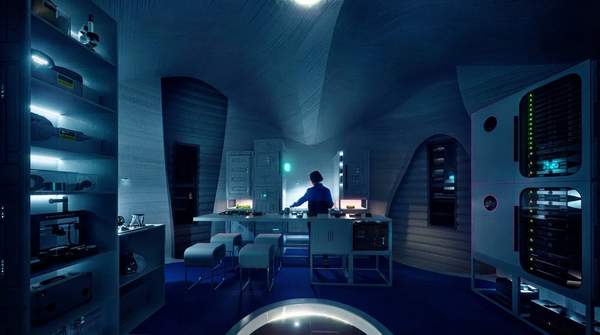
Comparing Critical Technologies for Long-Duration Human Mars Missions
This article analyzes critical technologies for long-duration human Mars missions, evaluating their readiness levels (TRL), resource demands, and impact on crew safety and mission feasibility. It highlights key areas like advanced propulsion, life support, ISRU, and power systems, guiding investment for future exploration.
Sep 30, 2026 · 5 min read
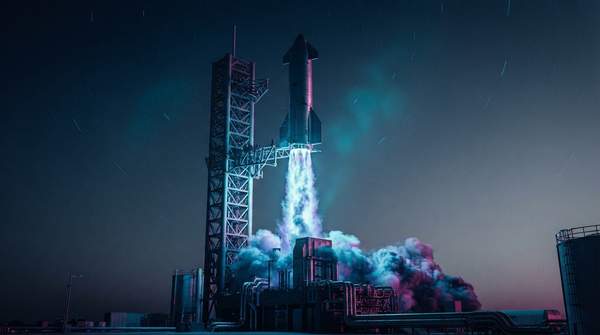
Starship Achieves Orbital Milestone Amidst Fiery End, Posing New Challenges for Artemis Lunar Program
SpaceX's Starship achieved its first orbital milestone, successfully reaching Earth orbit and deploying satellites. However, the test flight ended with a fiery explosion, raising concerns for its critical role in NASA's Artemis lunar program.
Sep 29, 2026 · 4 min read

Essential Technologies for NASA's StarBurst Gamma-Ray Mission
Imagine a satellite weighing just 250 kg, yet boasting over 500% the effective gamma-ray detection area of its colossal predecessor, the Fermi Gamma-ray Burst Monitor.
Sep 18, 2026 · 5 min read

IBM advances quantum error correction for fault-tolerant computing
Researchers have dramatically increased logical qubit survival rates from below 90 percent to more than 96 percent per error-correction cycle, according to The Quantum Insider .
Sep 16, 2026 · 5 min read

Superconductor magnets tested for 2026 fusion reactors
Existing superconductor magnets designed for fusion reactors, like those undergoing radiation tests in 2026, often become brittle in a reactor's intense high-radiation environment.
Sep 5, 2026 · 3 min read

MGE and Realta Fusion Partner on 200MW Wisconsin Fusion Plant
A Madison utility is directly investing in a nuclear fusion startup that recently powered a lightbulb with direct energy conversion, aiming to build a 200-megawatt plant capable of powering 150,000 ho
Sep 2, 2026 · 3 min read

NASA Roman Telescope to Spot Exoplanets, Probe Dark Energy
NASA's Nancy Grace Roman Space Telescope is projected to discover as many as 200,000 potential planets beyond the Solar System, a number that would multiply humanity's known exoplanet count by over 30
Aug 26, 2026 · 4 min read

IBM Connects First Modular Cryogenic Systems for Quantum Computing
Standing over eight feet tall and wide, IBM's first two operational modular cryogenic systems were successfully joined and cooled to 4 Kelvin in under five days, marking a significant engineering feat
Aug 21, 2026 · 2 min read

SpaceX rocket impact creates new double crater on moon
On March 4, 2022, a discarded SpaceX Falcon 9 upper stage, initially thought to be a single piece of space junk, slammed into the Moon's far side, unexpectedly carving not one, but two distinct crater
Aug 19, 2026 · 5 min read

Quantum Superposition & Entanglement in Quantum Computing
In a groundbreaking experiment, clusters containing over 7,000 atoms were observed to exist in multiple locations at once, their center-of-mass position delocalized by more than ten times their own di
Aug 14, 2026 · 5 min read

NASA astronaut Mike Fincke retires following medical evacuation
Just weeks after piloting a mission that returned in January, NASA astronaut Mike Fincke was medically evacuated from the International Space Station on January 7, 2025.
Aug 13, 2026 · 3 min read

Oracle Cloud Integrates Quantinuum's Helios Quantum Computer
In a monumental leap bringing the future of computing into today's enterprise, Oracle will physically install Quantinuum's 98-physical-qubit Helios quantum computer directly inside a US Oracle Cloud I
Aug 12, 2026 · 5 min read

SpaceX rocket stage impacted the Moon
An 8,800-pound piece of a SpaceX Falcon 9 rocket, launched years ago, slammed into the Moon on August 5, creating a new crater near the Einstein and Bell craters.
Aug 5, 2026 · 7 min read