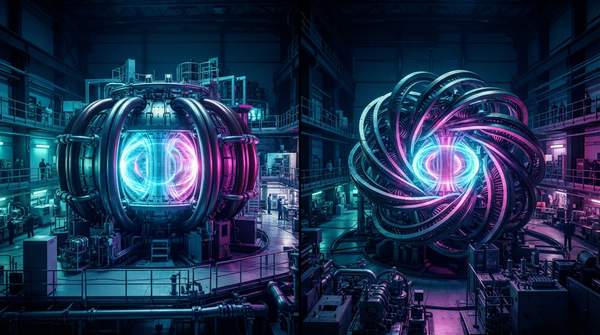
Two major fusion energy initiatives are pursuing fundamentally different designs to achieve the same transformative goal: commercially viable, grid-connected fusion power. In the United Kingdom, the Atomic Energy Authority (UKAEA) is advancing its STEP project based on a spherical tokamak. Meanwhile, the U.S.-based Type One Energy is commercializing a stellarator design. Their distinct approaches to confining superheated plasma represent a critical divergence in strategy, each aiming to solve the central engineering challenge of continuous, or "steady-state," operation that is essential for any functional power plant.
The Critical Hurdle: Sustained Fusion for Commercial Viability
The primary obstacle to commercializing fusion energy has not been the ability to initiate a fusion reaction, but rather the challenge of sustaining it long enough to be economically practical. For fusion to transition from a scientific experiment to a reliable power source, a plant must run continuously, delivering the uninterrupted energy flow required by an electricity grid. This concept, known as steady-state operation, is the real hurdle. It requires moving beyond the short-pulse successes of many past experiments to address the complex, competing requirements of a pilot power plant. Both the spherical tokamak and the stellarator are advanced concepts designed specifically to solve this problem, but they do so through profoundly different physical architectures and methods of controlling the plasma within.