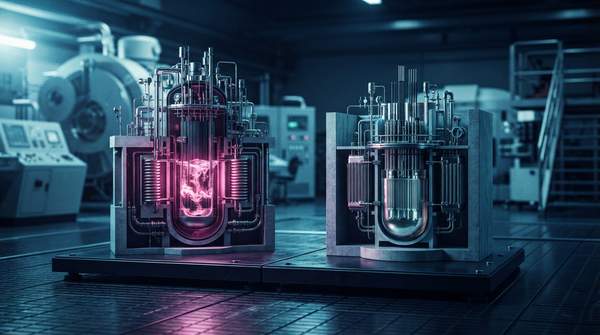
As nations seek cleaner and more efficient energy sources, advanced nuclear reactors present compelling alternatives to traditional designs. Among the most prominent are Molten Salt Reactors (MSRs) and Sodium-Cooled Fast Reactors (SFRs), each offering a distinct approach to fuel efficiency, waste management, and inherent safety. While both are designed to be safer and more efficient than previous generations of nuclear power plants, they operate on fundamentally different principles, from their choice of coolant to their core safety philosophies.
MSRs utilize molten fluoride or chloride salts as a coolant, which can have fissile materials dissolved directly into it, allowing the fission process to heat the salt. This design aims for high fuel utilization and the production of shorter-lived radioactive waste. In contrast, SFRs use liquid sodium as a coolant, a method that allows for higher operating temperatures and lower pressures than the water-based systems in most current commercial reactors. The U.S. Department of Energy notes that SFRs are specifically designed for the management of high-level waste, particularly plutonium and other actinides.
The Molten Salt Reactor Philosophy
Molten Salt Reactors represent a significant departure from conventional reactor technology, primarily through their use of a liquid fuel mixture. In many MSR designs, the nuclear fuel is dissolved directly into the molten salt coolant, which circulates through the reactor core. This approach allows for continuous processing and refueling, which contributes to higher fuel burnup rates and more efficient use of nuclear resources, according to the Generation IV International Forum, an international research cooperative. The goal is to use less fuel while generating waste that remains radioactive for a shorter period compared to other reactor types.
A key advantage highlighted by proponents is the reactor's operational conditions. MSRs function at or near atmospheric pressure, which, as the Generation IV International Forum points out, "significantly reduc[es] the risk of pressure-related accidents and explosions compared to high-pressure water reactors." This low-pressure environment is central to the MSR's safety case. Furthermore, many designs incorporate passive safety features, such as systems for passive cooling and the potential for the fuel salt to be drained away from the core in an emergency, enhancing the reactor's safety profile without depending on active intervention.
The Sodium-Cooled Fast Reactor Approach
Sodium-Cooled Fast Reactors are designed around a different set of principles, focusing on a closed fuel cycle and the ability to manage existing nuclear waste. These reactors use a fast neutron spectrum, which allows for more complete fission of uranium and other heavy elements like plutonium. This capability means SFRs can be configured to "breed" more fuel than they consume or to "burn" long-lived radioactive elements from the spent fuel of conventional reactors, effectively reducing the volume and long-term hazard of nuclear waste.
The use of liquid sodium as a coolant is critical to this design. Sodium has excellent heat transfer properties and a high boiling point, enabling the reactor to operate at high temperatures and low pressures, which improves thermal efficiency. From a safety perspective, fast reactors possess inherent characteristics that contribute to stability. The World Nuclear Association highlights a "strong negative temperature coefficient," a feature where the nuclear reaction automatically slows down as the reactor's temperature increases beyond normal operating levels. Experiments have also shown that in the event of a loss of coolant flow, these reactors can shut themselves down without external intervention.