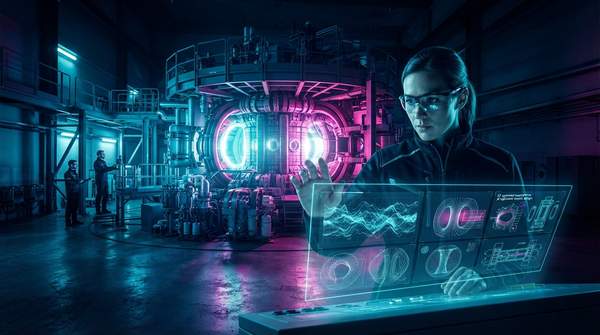
Artificial intelligence has moved from buzzword to working tool in fusion energy research, and three application areas stand out: real-time plasma control in tokamaks, materials modeling for extreme reactor environments, and AI-driven simulation and design of fusion machines. In each case, a specific technique—deep reinforcement learning, machine learning-assisted modeling, or physics-informed AI platforms—is being matched to a concrete problem by named institutions, including Google DeepMind, the Swiss Plasma Center at EPFL, Princeton engineers, UKAEA, and ITER.
Introduction: AI's Role in Accelerating Fusion Energy
Fusion's central difficulty is well known: sustaining a plasma hotter than the sun's core inside a machine, using materials that survive punishing heat and radiation, and designing devices whose geometry is extraordinarily complex. AI is being applied at each of these pressure points. ITER's own reporting highlights the value of machine learning, particularly physics-informed models that use real-world physical laws to predict behavior and guide system control. As one researcher quoted by ITER put it, "It's about using actuators and sensors in harmony to stabilize plasma in real time."
The scope of institutional commitment is broad. UKAEA's international computing program explicitly targets exascale computing to accelerate engineering simulations, materials modeling, and the analysis of operational data, with the stated goal of creating "a real time digital twin of a fusion machine." Google DeepMind, meanwhile, has published work showing that reinforcement learning can control the magnetic configuration of a tokamak and is now building on that foundation for future devices. This article focuses on magnetic confinement fusion—tokamaks and stellarators—where the evidence for applied AI is strongest.
Plasma Control: Taming the Fusion Fire with Reinforcement Learning
The most mature application is real-time plasma control. A tokamak holds plasma inside a magnetic cage, and holding that cage steady—especially when the plasma takes on complex shapes—demands control decisions faster than human operators or conventional tuning can manage. Google DeepMind, working with the Swiss Plasma Center at EPFL, demonstrated that reinforcement learning can control a tokamak's magnetic configuration directly: the AI learns, through repeated simulated trial and error, which control actions keep the plasma where it needs to be.
The next frontier is breadth. DeepMind's fusion team describes developing an "AI pilot" for real-time control and using reinforcement learning to quickly tune traditional control algorithms for a specific plasma pulse. Their work also relies on TORAX, a fast plasma simulator that will be validated and calibrated against past tokamak data and high-fidelity simulations, giving confidence in its accuracy before the SPARC device begins operations. The combination of pulse optimization and optimal control, they argue, could push SPARC further and faster toward its goals.
Princeton researchers are tackling a complementary problem: instability. Engineers at Princeton, working with colleagues at the Princeton Plasma Physics Laboratory, built an AI controller that uses a limited set of diagnostics to avoid one specific type of instability. Co-author Ricardo Shousha, a postdoc at PPPL, described the expansion path: "You could imagine one large reward function that turns many different knobs to simultaneously control for several types of instabilities." In other words, the same reinforcement learning framework could graduate from preventing a single failure mode to managing many at once.
Materials Science: Accelerating Discovery for Extreme Environments
Fusion does not need a single miracle material; it needs an array of materials, each matched to a component and a duty. That is how UKAEA frames the challenge, and it is why the organization is exploring artificial intelligence, machine learning, and exascale computing power specifically for materials modeling. The stated aim is that developed tools and methodology will accelerate the fusion energy community's understanding of how materials actually perform in operation—how they behave under high heat and radiation over time, not just in isolated laboratory tests.
ITER is likewise involved in international computing efforts that apply AI to materials science research. The practical payoff is speed: instead of relying solely on slow physical irradiation and aging experiments, researchers can use AI-assisted models to narrow the candidate field and predict operational performance before components are ever installed. The evidence here describes the modeling approach broadly rather than naming a specific neural network architecture, which itself reflects where the field stands—materials modeling is an active research direction with committed institutional backing, not yet a deployed control system.
Reactor Design: Digital Twins and AI-Native Engineering
The third application area sits upstream of operation, in design and simulation. UKAEA's program links exascale computing to accelerating engineering simulations and enabling a real-time digital twin of a fusion machine—a live, data-fed model that can be tested and stress-checked far more cheaply than the physical device. ITER's reporting points to the same trend, noting the emergence of AI-native platforms that combine multiple modes of reasoning. One example is Atlas, developed by the New York-based startup Arena: an AI-native system that combines physics-based reasoning with large language models, already used to streamline engineering processes at AMD, that helps design, debug, and optimize complex systems.
Parametric CAD and immersive modeling also feature in ITER's account of how AI is changing reactor design workflows. The common thread is iteration speed: AI-assisted simulation lets researchers explore more design variants and catch problems earlier, reducing the cost of each design cycle. The evidence ties digital twins to fusion machines generally and to tokamaks in particular, rather than to stellarators specifically.
AI in Fusion Energy: A Comparative Overview
The table below maps each application area to the problem it addresses, the AI technique involved, and the institutions leading the work. The comparison shows a clear division of labor: reinforcement learning dominates real-time control, where speed of decision matters most, while machine learning modeling and digital twins carry the load in materials and design, where the bottleneck is the sheer number of scenarios to evaluate.
| Application Area | Problem Solved | AI Technique(s) Used | Example Project/Institution |
|---|---|---|---|
| Plasma Control & Diagnostics | Stabilizing complex plasma shapes in real time and preventing specific types of instabilities, with a goal of handling multiple instabilities simultaneously | Deep reinforcement learning, trained and tuned with fast plasma simulators such as TORAX | Google DeepMind with the Swiss Plasma Center at EPFL; Princeton Engineering and PPPL researchers |
| Materials Science | Accelerating the discovery and modeling of materials that can withstand high heat and radiation in fusion reactors | AI and machine learning for materials modeling, paired with exascale computing | UKAEA and ITER, through international computing efforts |
| Reactor Design & Simulation | Speeding up engineering simulation and design iteration for fusion machines | Digital twins, physics-informed machine learning, and AI-native platforms combining physics reasoning with language models | UKAEA's digital twin program; Arena's Atlas platform, cited by ITER |
Accelerating the Fusion Future: A Call to Action
Researchers and institutions should continue to prioritize and invest in AI-driven approaches for plasma control, materials discovery, and reactor design to accelerate the realization of practical fusion energy. The evidence supports that prioritization on each front: DeepMind's reinforcement learning controllers are being prepared for SPARC's start of operations, Princeton's team has a published path from single-instability control to multi-instability reward functions, and UKAEA and ITER have committed computing programs in materials modeling and digital twins.
The measurable indicator to watch is the increased number of published research papers, successful plasma confinement experiments, and new reactor design iterations utilizing AI techniques. The next concrete milestone in that sequence is SPARC beginning operations, when DeepMind's calibrated TORAX simulations and AI control work meet real plasma for the first time.
Sources
- Google DeepMind is bringing AI to the next generation of fusion energy
- Princeton Engineering - Engineers use AI to wrangle fusion power for the grid
- International Computing — UKAEA Fusion Energy
- AI ignites innovation in fusion — ITER - the way to new energy