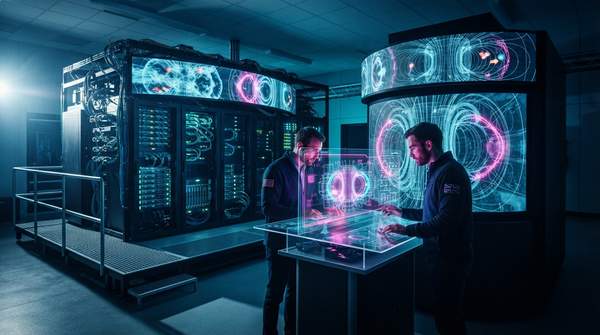
The United Kingdom and the United States have formally linked their fusion supercomputing platforms, creating a transatlantic partnership designed to train shared artificial intelligence models on experimental data from both nations' spherical tokamaks. Announced on 14 September 2026 at the Global Fusion Policy Summit in London, the agreement joins UKAEA's SUNRISE supercomputer with the Princeton Plasma Physics Laboratory's STELLAR-AI platform in what the two organisations call the SUNRISE–STELLAR-AI Federation, with the explicit aim of accelerating the UK's STEP Fusion and the US STAR reactor concepts.
Transatlantic Fusion: The SUNRISE–STELLAR-AI Federation
The Federation was established through a Joint Declaration of Intent signed at the London summit, bringing together the UK Atomic Energy Authority and the US Department of Energy's Princeton Plasma Physics Laboratory. According to UKAEA's announcement, the two organisations have "joined forces to link their advanced fusion supercomputing platforms, using artificial intelligence to accelerate fusion energy's development," a framing that positions the partnership as a bid to strengthen UK–US leadership in science and innovation while creating what the authority describes as world-leading transatlantic AI capability for fusion.
The agreement builds on a memorandum of understanding signed between UKAEA and PPPL in June 2026, formalising a relationship that has now acquired a specific technical mandate. The UK government's Department for Energy Security and Net Zero, which announced the partnership, said the supercomputing collaboration combines "world-leading expertise in AI, computing and fusion to accelerate the development of commercial fusion." The department also framed the deal in economic terms, with ministers pointing to investment, jobs and growth as intended outcomes alongside the scientific work.
The SUNRISE–STELLAR-AI Federation: A Data-to-Design Pipeline
The Federation's workflow can be traced as a sequential pipeline, from existing experiments through shared computation to future reactor design. Each stage below is drawn from the parties' own announcements and specialist reporting on the agreement.
| Stage | Component | Role in the pipeline |
|---|---|---|
| 1. Data source | MAST Upgrade (UKAEA, Oxfordshire) | Contributes experimental data from a compact spherical tokamak |
| 1. Data source | NSTX-U (PPPL, New Jersey) | Contributes experimental data from a similarly designed US spherical tokamak |
| 2. Computational platform | SUNRISE–STELLAR-AI Federation | Links the two supercomputing systems so both train the same AI models |
| 3. Process | Joint AI model training | Researchers train shared AI models using experimental data from both facilities, utilizing the platform best suited for specific tasks |
| 4. Target application | STEP Fusion (UK) and STAR (US) | More powerful AI models are applied to accelerate the design of both future reactor concepts |
The pipeline's logic is cumulative: data from two machines feeds one federated training process, and the resulting models are then directed at two national reactor programmes. As PPPL noted in the announcement, linking the two computer systems enables researchers to train shared AI models using experimental data from both facilities, utilizing the platform best suited for specific tasks. The Federation is therefore not a single new computer but a coordinated use of two existing platforms toward a shared modelling goal.
Strategic Rationale: Why Combine Experimental Data?
The scientific case for the partnership rests on a data problem. Fusion research generates huge amounts of experimental data, but as reporting on the agreement explains, individual machines and labs often do not produce enough of their own to train reliable AI models. The Federation addresses this by pooling UK and US data to support the creation of more powerful AI models, which could then be applied to the design of future fusion power plants, potentially shortening development timelines.
The choice of MAST Upgrade and NSTX-U is not arbitrary. Both are compact spherical tokamaks with similar designs, which makes them well suited for joint AI training. UKAEA stated the underlying advantage directly: "When different facilities are combined, researchers can develop more powerful machine-learning models that better capture the underlying physics and help accelerate future fusion projects, including the UK's Spherical Tokamak for Energy Production (STEP Fusion) and US concepts such as PPPL's Spherical Tokamak Advanced Reactor (STAR)." Because the two machines probe similar physics, their combined datasets give AI models a broader empirical foundation than either facility could provide alone.
Joe Milnes, Executive Director for Engineering and Computing at UKAEA, framed the collaboration in terms of the field's scale. "Fusion is one of the great scientific and engineering challenges of our time," he said. "To solve these challenges, fusion needs partnerships."
Broader Context and Goals
The supercomputing Federation was the centrepiece of a wider set of UK–US announcements at the Global Fusion Policy Summit. Alongside the computational agreement, the two countries signed a Joint Statement committing to closer cooperation on regulating fusion energy, which the UK government said is intended to help attract investment and support growth of the sector. The pairing is deliberate: technical acceleration and regulatory alignment are presented as complementary routes to commercial fusion.
UKAEA's announcement also emphasised investment in people and skills needed for the future fusion sector, positioning the Federation as a shared platform for the next generation of scientists as well as a computational tool. The UK government's framing extended this to industrial policy, with FCDO Minister for the Americas Chris Elmore saying the partnership is "helping British businesses and researchers access the investment, knowledge and international partnerships needed to succeed in the industries of the future."
The agreement does not commit either country to a timeline for commercial fusion, and neither announcement specifies when the linked platforms will begin joint operations. What the declarations do establish is a concrete mechanism: shared data, shared models and shared machines, directed at two named reactor programmes.
Accelerating Fusion: A Shared Path to Commercial Power
The US and UK are committed to accelerating the development of commercial fusion energy through a federated supercomputing and AI platform. The measurable indicator of whether that commitment is being delivered is the successful technical integration of the SUNRISE and STELLAR-AI platforms and the commencement of joint AI model training using shared experimental data from MAST Upgrade and NSTX-U. Readers tracking this story should watch for exactly that milestone: once the two systems are linked and shared models begin training on combined tokamak data, the Federation will have moved from declaration to operation, with STEP Fusion and STAR as the downstream tests of whether the pipeline shortens the design cycle as intended.
Sources
- UK and US fusion strike partnership to accelerate clean energy — GOV.UK
- UK & US Link Supercomputers to Develop Nuclear Fusion Energy — Energydigital
- UK and US fusion supercomputers to be linked across Atlantic — UKAEA Fusion Energy
- UK, USA enhance cooperation on fusion energy — World Nuclear News