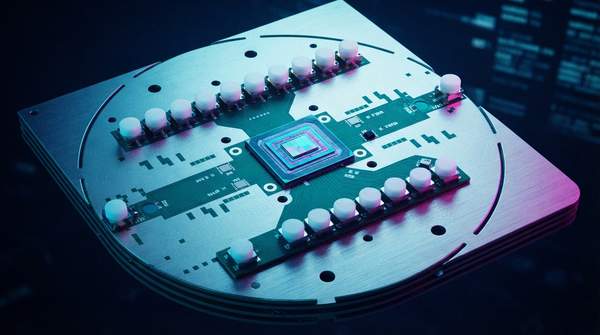
A theoretical proposal led by physicists at the University of São Paulo and the Beijing Institute of Technology suggests that a qubit can be read out by measuring an electric supercurrent that the qubit itself generates. In an Andreev qubit—a superconducting qubit defined in a quantum-dot Josephson junction—the coherent evolution of the qubit's quantum state produces an oscillating supercurrent whose time-dependent variation acts as a signature of that state. Because the current arises from the qubit's internal dynamics rather than from a direct probe of its state, the authors argue the readout can reconstruct the qubit's information with minimal perturbation, without collapsing the quantum state and without the auxiliary qubits, or ancillas, that conventional non-destructive readout requires.
The Challenge of Qubit Measurement
Reading a qubit is one of quantum computing's most delicate operations. A qubit's information lives in a superposition of states, and conventional measurement collapses that superposition, destroying the very resource the computer depends on. To avoid this, existing non-destructive techniques typically transfer the qubit's information to an ancilla—an auxiliary qubit prepared in a known state—and then measure the ancilla instead of the qubit of interest. The original research paper describing the supercurrent proposal is blunt about the cost of this approach: the multitude of ancilla preparations, information transfers, and ancilla measurements in these protocols creates an intrinsic overhead for information processing.
That overhead compounds across a machine. Each readout demands synchronization between the data qubit and its ancilla, and after measurement the pointer states must be reset quickly so the measured qubit can be reused rapidly—a requirement that work on other qubit platforms, such as Kerr cat-state qubits, identifies as essential for fault-tolerant computation. The São Carlos–Beijing team's proposal attacks this complexity at its root: if the qubit's own dynamics produce a directly measurable current, the entire ancilla apparatus—preparation, transfer, and measurement—drops out of the architecture, along with the successive resets that accompany it.