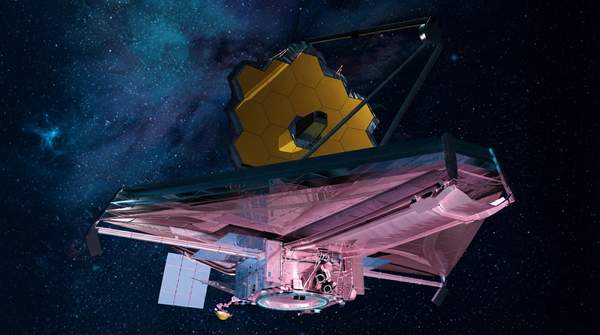
The James Webb Space Telescope's Mid-Infrared Instrument, or MIRI, is the observatory's only instrument that covers the mid-infrared, spanning roughly 5 to 28 microns. That range is what sets it apart: according to NASA's Webb mission team, astronomers rely on MIRI to study cooler objects like debris disks—which emit most of their light at these wavelengths—and extremely distant galaxies whose light has been shifted into the mid-infrared over time. Its work splits into three families of modes: imaging, spectroscopy, and coronagraphy, each aimed at a different class of question.
Understanding MIRI: Webb's Mid-Infrared Eye
MIRI packs several functions into a single box. NASA's instrument overview describes four key components: a camera that captures two-dimensional images of regions of space; a spectrograph that spreads light into a spectrum so the brightness of each individual wavelength can be measured; a coronagraph—opaque disks used to block the bright light of stars in order to detect the much fainter light of planets and debris disks orbiting them; and an Integral Field Unit (IFU), a combination of camera and spectrograph that maps spectra across a field of view to understand variation over space.
STScI's JWST user documentation gives the precise operating span as 4.9 to 27.9 microns. The instrument is a joint achievement: NASA's pages credit it to a European consortium, and ESA's science portal notes that the observatory's science goals required one versatile mid-infrared instrument rather than separate machines for each task.
Why Mid-Infrared Matters: Unveiling the Universe's Secrets
Two physical facts make the mid-infrared indispensable. First, cosmic expansion stretches light: ultraviolet and visible light emitted by the earliest galaxies gets shifted to longer wavelengths as the universe expands. STScI's documentation identifies MIRI's wavelengths as the tool for identifying and characterizing the first galaxies at redshifts greater than z > 7—light that began its journey at far shorter wavelengths than the ones at which it finally arrives.
Second, temperature governs where an object radiates. Cooler bodies such as proto-planetary disks of gas and dust around young stars emit most of their light in the mid-infrared, which is why MIRI is used to analyze warm dust and molecular gas in these systems, and to measure the sizes of faintly visible comets and Kuiper Belt objects. The same dust also obscures visible light, and as AmericaSpace's coverage of the instrument's installation noted, MIRI can see through the dust that hides phenomena such as star formation.
MIRI's Observational Modes: A Toolkit for Discovery
Each observing mode exists to solve a specific problem. Imaging answers "what does it look like and how bright is it?" at a chosen wavelength. Coronagraphy answers "what faint object is hiding next to something dazzling?" Spectroscopy answers "what is it made of?" MIRI's spectroscopy comes in two flavors: low-resolution spectroscopy from 5 to 10 microns, and medium-resolution spectroscopy at R ~ 3000 delivered through the IFU. The table below matches each mode to its hardware and its scientific calling.
MIRI's Observational Modes at a Glance
| Observational Mode | Key Component(s) | What It Does | Primary Scientific Application |
|---|---|---|---|
| Standard Imaging | Camera, with broad and narrow band filters | Captures two-dimensional images of regions of space across MIRI's full range (4.9 to 27.9 μm) | Wide-field views of targets from distant stellar populations to comet and Kuiper Belt object sizes |
| Coronagraphic Imaging | One Lyot and three 4-quadrant phase mask coronagraphs, optimized for the mid-infrared | Blocks the bright light of a central star to reveal much fainter nearby objects | Direct imaging of young warm exoplanets and protoplanetary or debris disks |
| Low-Resolution Spectroscopy | Spectrograph (fixed slit and slitless modes) | Spreads light into a spectrum to measure the brightness of individual wavelengths, covering 5–10 μm | Spectroscopy of exoplanet atmospheres and faint-source chemical analysis |
| Medium-Resolution Spectroscopy (IFU) | Integral Field Unit (combined camera and spectrograph) | Captures and maps spectra across a small field of view simultaneously, covering 5–28.5 μm | Detailed studies of extended objects like galaxies and nebulae, and spectra of exoplanet atmospheres |
The framework is simple once the components are separated: the camera gives the picture, the coronagraph removes the glare, and the spectrograph turns light into a chemical inventory. ESA's science portal emphasizes that MIRI was designed to provide all of these functions in a single instrument, which is why the same hardware can serve both exoplanet hunters and cosmologists.
Analyzing Exoplanet Atmospheres with MIRI
Studying an exoplanet's atmosphere is fundamentally a glare problem: a planet is thousands of times fainter than its host star. NASA describes the coronagraph's role as blocking starlight so the much fainter light of planets and orbiting debris disks can be detected. In practice, the observation chains the components together—the coronagraph suppresses the star's light, and the captured light that has passed through or been emitted by the planet's atmosphere is then dispersed by the spectrograph, which measures the brightness of each individual wavelength.
That spectrum is where chemistry enters. Molecules absorb and emit at characteristic wavelengths, and as AmericaSpace reported at the instrument's installation, MIRI can see light emitted by molecules that reveals physical information including temperature, mass, and chemical composition—and, its proponents argued, could even reveal conditions relevant to the presence of life on other planets. STScI's documentation likewise names spectroscopy of the atmospheres of young warm exoplanets among MIRI's core uses, alongside direct imaging of the planets themselves.
Exploring the Early Universe and Star Formation
At the other end of MIRI's scientific portfolio sits the early universe. Because the first galaxies' light arrives stretched by cosmic expansion into the mid-infrared, MIRI is one of Webb's key instruments for identifying and characterizing galaxies at redshifts beyond z > 7—the era when the earliest galaxies were forming. Imaging through its filters locates and measures these sources; spectroscopy through the IFU can confirm their distances and properties.
Closer to home in cosmic terms, MIRI is turned on star birth. STScI's documentation lists analysis of warm dust and molecular gas in young stars and proto-planetary disks among its central uses, and NASA points to the physics of newly forming stars as a core MIRI application. As one interviewee quoted in AmericaSpace's installation coverage put it, MIRI's "sensitive spectroscopy… contains many unique spectral and diagnostic features that will enable us to study the properties and materials around forming stars in extreme detail."
MIRI's Enduring Legacy in Astronomy
MIRI's unique mid-infrared capabilities, delivered through its diverse observational modes, are indispensable for advancing our understanding of exoplanet atmospheres and the universe's earliest epochs. The instrument's value rests on a pairing no other Webb instrument replicates: a wavelength band where both redshifted light from the first galaxies and thermal emission from cool objects concentrate, and a toolkit—camera, coronagraphs, and two spectrographs—designed to interrogate that band. Its ongoing contribution can be tracked in the measurable indicator the instrument's own documentation anticipates: continued publication of scientific papers detailing discoveries made using MIRI data, particularly concerning exoplanet atmospheric compositions and observations of high-redshift galaxies.
Sources
- Mid-Infrared Instrument (MIRI) - NASA Science
- JWST Mid Infrared Instrument - JWST User Documentation — JWST DOCS
- MIRI - the mid-infrared instrument on JWST - JWST - Science Portal
- VIDEO: Mid-Infrared Instrument Installed for NASA’s James Webb Space Telescope - AmericaSpace — AmericaSpace - For space explorers