Enhanced Geothermal Systems and Advanced Geothermal Systems differ at the most basic physical level: EGS extracts heat by convection, circulating fluid through fractured hot rock, while AGS extracts heat purely by conduction through sealed pipes that never touch the reservoir. That single distinction drives everything else—why EGS needs hydraulic stimulation and carries induced-seismicity risk, why AGS avoids both but struggles with drilling costs and slower heat transfer, and why EGS is already producing at commercial scale while AGS has yet to prove economically bankable.
Core Technological Differences: Heat Transfer and Rock Stimulation
In an Enhanced Geothermal System, water is injected through one well, flows through a network of fractures created in hot, dry crystalline rock—typically granite or basement rock at depths of 3 to 10 kilometers, commonly 3 to 7—and returns to the surface through production wells as hot fluid. Because these target formations have low or absent natural permeability, that permeability must be created: EGS requires hydraulic stimulation, specifically hydro-shearing, to establish the flow paths the system depends on. The rock type matters because the fluid must directly contact a large, hot fracture surface for convection to carry away meaningful heat.
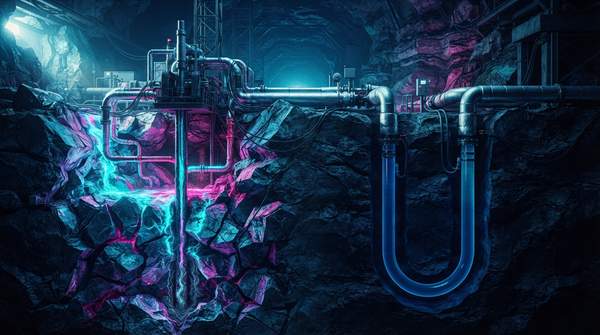
An Advanced Geothermal System—often used interchangeably with "closed-loop" geothermal—inverts this logic. The working fluid, water or carbon dioxide, stays sealed inside pipes, configured as a U-loop or coaxial wellbores, and heat moves across intact wellbore walls by conduction alone. According to a 2026 report by Robin Gaster for the Information Technology and Innovation Foundation, AGS requires no natural permeability and no EGS-style stimulation, works in any hot rock rather than only crystalline basement, and operates at shallower depths, generally 2 to 7 kilometers, with temperatures above 100°C, typically 100 to 250°C.
The physical penalty of the sealed design is speed. As Kara Hunt explained in a 2025 Clean Air Task Force introduction to closed-loop systems, "Conduction can't transfer thermal energy (heat) as fast as convection, which leads to a quicker drawdown in heat of the reservoir over time relative to conventional geothermal systems." She notes this can be balanced by extending the total length of piping in the system—a fix that adds capital cost and drilling complexity.
Operational Risks and Design Characteristics Compared
The two designs concentrate their risks in different places. For EGS, the key challenge is induced seismicity: hydraulic stimulation of hot rock can trigger earthquakes, a concern that Gaster's report flags as central to public acceptance and fracture control. Reservoir variability compounds the engineering problem—output depends on how well the stimulated fracture network performs, and that performance is partly hostage to geology that cannot be fully characterized in advance.
AGS moves the risk from the reservoir to the drill bit and the balance sheet. With no fracture network to create or manage, the technology sidesteps seismicity almost entirely and gains predictability from its engineered geometry. But the closed-loop approach faces drilling costs as its primary obstacle, compounded by the slow conductive heat transfer that limits how much energy each well can deliver. Gaster's comparison characterizes AGS power output as lower than standard geothermal output, with the technology best suited to district heating rather than utility-scale electricity generation.