Fusion energy's central obstacle is not the physics of igniting a plasma—experiments have produced fusion reactions—but the accumulation of distinct, unsolved problems in plasma science, materials durability, fuel supply, and industrial systems integration that must all be solved simultaneously before a commercially viable power plant can exist. A 2022 experiment at the National Ignition Facility generated more energy from a fusion reaction than the direct energy used to start it, yet stakeholders surveyed by the U.S. Government Accountability Office still project timelines to commercial fusion ranging from 10 years to several decades. The gap between those two facts is the story of this article: a set of challenges that are not one hard problem but many, each with its own nature and its own solution pathway.
Introduction: The Promise and the Path to Commercial Fusion
The appeal of fusion is straightforward. The Department of Energy describes commercial fusion as having the potential to help meet growing clean energy needs in the United States and worldwide, and to supply combined heat and power for hydrogen production, industrial heat, carbon capture, and desalination. Analysts at the University of Pennsylvania's Kleinman Center for Energy Policy note that fusion could provide reliable baseload power with a relatively small geographic footprint, that it does not produce long-lived radioactive waste in the way fission plants do, and that it carries no risk of a meltdown from exponential chain reactions.
But the same assessments make clear that none of that value arrives automatically. The GAO identifies challenges spanning fundamental science, engineering, and institutional coordination, while the Department of Energy acknowledges that fusion carries technology gaps in precisely the areas—materials and the fuel cycle—that a power plant cannot avoid. Understanding why these specific hurdles are hard, and how they differ from one another, is the key to evaluating any claim that commercial fusion is near.
Scientific Hurdles: Mastering the Burning Plasma
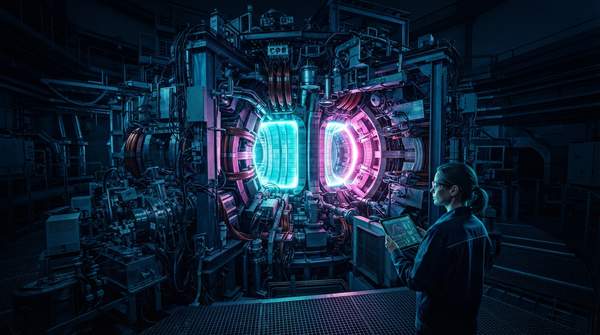
The most fundamental open question concerns burning plasmas—plasmas whose main source of heat is the fusion reaction itself rather than an external heating system. According to the GAO, researchers do not fully understand how such plasmas behave. This is not a minor gap: a commercial reactor must run on its own output, and no experimental device has yet operated in that self-heating regime long enough to characterize it comprehensively.
The problem compounds because simulation cannot substitute for experiment. The GAO reports that while researchers have made advancements in modeling plasma behavior, they lack sufficient experimental data to validate their simulations. The Fusion Industry Association frames the same point from the industry side: creating plasma, heating it to roughly 100 million degrees Celsius, confining atoms closely enough to collide, and holding those conditions long enough for sufficient collisions is the scientific baseline that any viable machine must deliver. The engineering challenge, in its framing, is sustaining those conditions reliably and economically—but the science of what a burning plasma does once sustained remains incomplete.