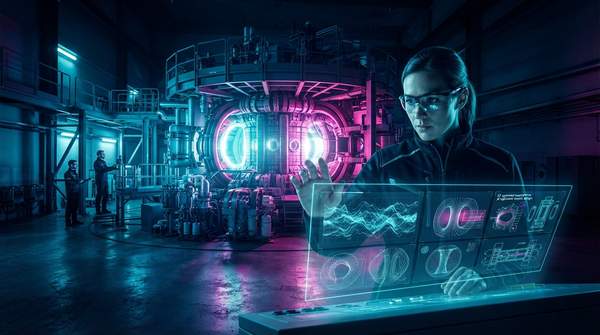
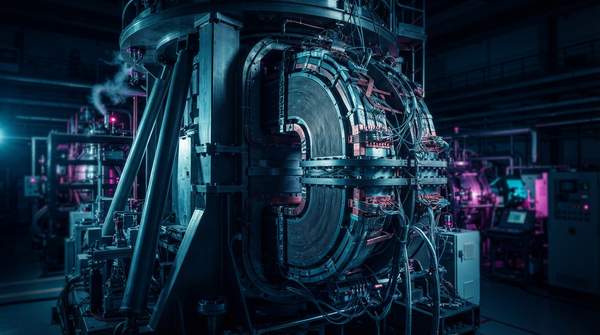
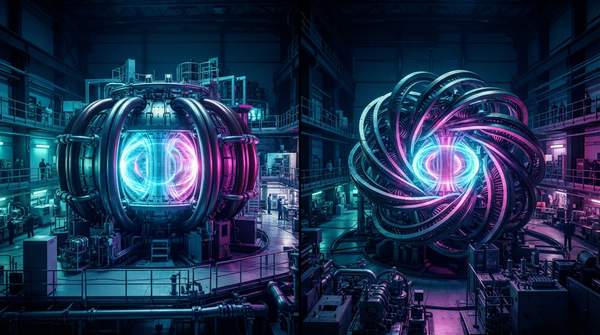
Existing superconductor magnets designed for fusion reactors, like those that underwent radiation tests in 2026, often become brittle in a reactor's intense high-radiation environment. This fragility poses a critical barrier to harnessing sustainable fusion energy. Quantum Formatics founder Jason Gibson indicates that artificial intelligence can assist in discovering hardened superconductors, vital for powering the strong magnets needed in future nuclear fusion designs. This offers a tangible path to unlock fusion's immense energy potential.
However, the development of practical nuclear fusion has been hampered by the inherent fragility of these existing superconductor magnets when exposed to extreme radiation. AI is now rapidly accelerating the discovery of resilient new materials, directly addressing this long-standing limitation.
Based on AI's demonstrated capability to rapidly screen and identify advanced materials, the timeline for achieving viable fusion energy and revolutionizing global energy efficiency appears significantly shortened. This technological advancement positions fusion as a near-term energy solution, rather than a distant dream.
Radiation's Impact on Fusion Reactor Magnets
Fusion reactors demand magnets capable of enduring extreme conditions. Existing superconductor magnets, crucial for confining superheated plasma, degrade rapidly when exposed to the high-radiation environment inside a reactor. This brittleness compromises structural integrity and operational lifespan, according to Quantum Formatics founder Jason Gibson. Overcoming this material degradation is paramount for any practical fusion reactor design, making the search for resilient materials a central challenge. The need for materials that can withstand these radiation tests remains urgent.
Accelerating Superconductor Discovery with AI
The pace of material discovery has dramatically increased with AI integration. Periodic Labs, for instance, developed an AI-powered robot-arm system capable of testing 1,000 candidate superconductors daily, as reported by IEEE Spectrum. This breakthrough speed addresses the historical bottleneck of finding radiation-hardened superconductors, potentially accelerating fusion timelines by decades. The ability to rapidly screen such a high volume of materials means the bottleneck is shifting from discovery to deployment, challenging traditional R&D timelines across high-tech industries.

Beyond Fusion: Energy Efficiency Gains
The impact of advanced superconductor research extends far beyond fusion reactors. New discoveries in these materials could significantly boost energy efficiency in existing high-energy consumption sectors. Data centers and hospital magnetic-resonance-imaging (MRI) equipment, for example, could become 10 to 1,000 times more efficient, according to IEEE Spectrum. Such efficiency gains would translate into substantial operational cost reductions for energy-intensive industries. Companies failing to integrate AI-driven material innovations will face rapidly escalating operational costs and competitive disadvantage.
The Path to Widespread Superconductor Applications
The accelerated discovery of robust superconductors paves the way for a new generation of reliable and efficient fusion reactors. This iterative process, enabled by AI, suggests consistent, incremental improvements rather than waiting for a single, elusive breakthrough. The benefits, from fusion viability to industrial efficiency, will likely improve steadily. Based on Jason Gibson's insights, the fragility of existing fusion magnets, once a critical barrier, is now being systematically dismantled by AI-assisted material discovery, positioning nuclear fusion as a viable energy source much sooner. By 2030, this rapid material development could see the first commercial fusion prototypes utilizing these AI-discovered, hardened superconductor magnets.
Frequently Asked Questions About Superconductors and Fusion
What are superconductor magnets used for in fusion reactors?
Superconductor magnets are essential for creating the powerful magnetic fields needed to confine the superheated plasma within a fusion reactor. These fields prevent the plasma, which can reach millions of degrees Celsius, from touching the reactor walls, allowing fusion reactions to occur. Without strong, stable magnetic confinement, sustained fusion is impossible.
How does radiation affect superconductor magnets?
The intense neutron radiation produced during fusion reactions can damage the crystal lattice structure of existing superconductor materials. This damage leads to a loss of superconducting properties, making the magnets less efficient or causing them to fail entirely. Such degradation necessitates frequent, costly replacements or limits reactor operational time.
What are the latest advancements in fusion reactor magnet technology?
The most significant advancements in 2026 involve AI-powered material discovery systems, such as Periodic Labs' robot, rapidly identifying new superconductor candidates. This technology accelerates the search for materials that can withstand extreme radiation and high temperatures, directly addressing a critical design challenge for next-generation fusion reactors. The focus is on finding materials with enhanced resilience and performance.