For humans to travel to the Moon, Mars, and beyond, they must solve a fundamental problem: how to survive for months or years far from Earth’s life-sustaining resources. The sheer quantity of air, water, and food required for a long-duration mission makes it impractical to simply pack everything at the start. The solution lies in developing closed-loop life support systems that recycle waste products into the essentials for survival, creating a self-sustaining environment inside a spacecraft. These regenerative systems are critical for making a long-term human presence beyond Earth both possible and sustainable. A potential mission to Mars, for instance, would need to support a crew for nearly two years.
Instead of carrying an enormous stockpile of supplies that must be launched from Earth, a circular recycling system can produce the oxygen, water, and food the crew needs by continuously processing their waste.
The Limits of Open-Loop Systems
Early and shorter-duration space missions relied on what engineers call "open-loop" life support. In this model, all necessary resources—such as oxygen, water, and food—are brought from Earth in storage tanks and containers. As the crew consumes these supplies, their waste products, like exhaled carbon dioxide and wastewater, are collected and stored for eventual disposal. This approach is straightforward but has a significant drawback: the amount of required supplies increases in direct proportion to the mission's length and the size of the crew. For a short trip to low Earth orbit, this is manageable. But for a multi-year journey to another planet, the mass and volume of stored resources would become prohibitively large and expensive to launch. Similarly, systems like carbon dioxide scrubbers become ineffective over time and would require frequent replacement, a logistical impossibility on a deep-space voyage.
The Three Pillars of a Closed-Loop System
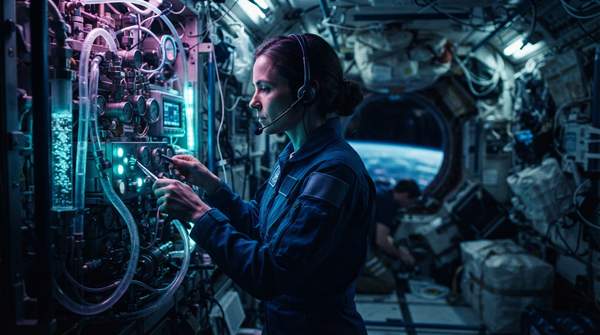
To overcome the limitations of open-loop designs, space agencies are focused on creating "closed-loop" or regenerative systems. These systems require an initial supply of resources but are designed to process waste products to recover and reuse valuable materials, dramatically reducing dependence on resupply from Earth. A fully self-sufficient system is built around three primary functions, often called "loops," that manage the flow of essential resources. First is the air revitalization loop, which focuses on maintaining a breathable atmosphere. This involves actively removing the carbon dioxide (CO₂) exhaled by the crew and generating fresh oxygen to replace what is consumed. Second is the water recovery loop.
This system is designed to collect and purify all sources of wastewater, including urine, hygiene water, and condensation captured from the cabin air. The goal is to turn this water back into clean, potable water for drinking and other uses. The third and most complex pillar is the food production and waste management loop. This aims to grow food onboard and recycle organic waste. The European Space Agency’s MELiSSA program, for example, is a long-term effort to develop a bioregenerative system that uses microorganisms and higher plants to recycle waste, produce food, and contribute to air and water regeneration.