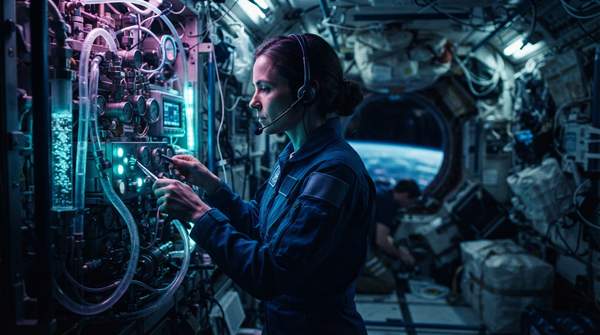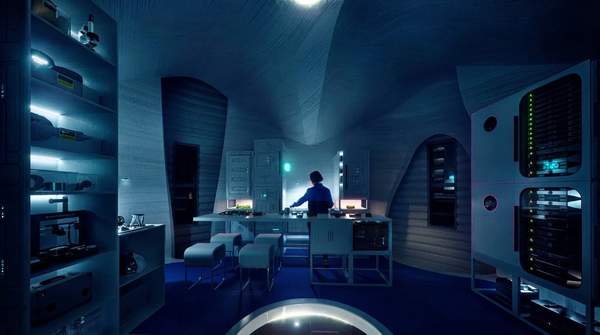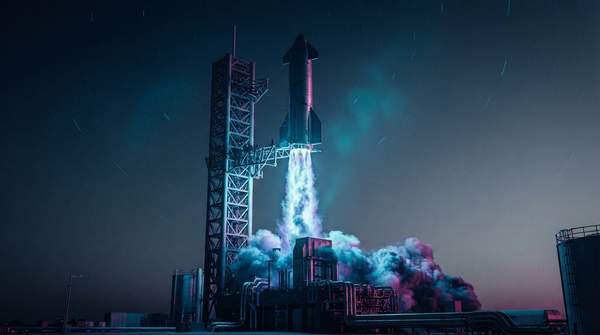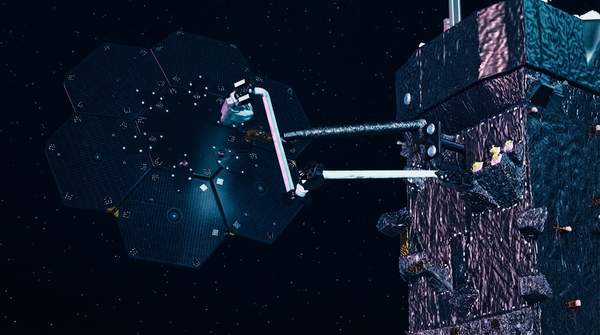
Autonomous in-space manufacturing rests on three interdependent technologies: robotic systems that physically manipulate hardware, autonomous control software that lets those robots work without constant human direction, and materials engineered to survive being built and used in orbit. The reason these capabilities are being pursued at all is a hard physical constraint: every structure flown to space today must first fit inside a rocket. As an editorial on robotic in-space servicing, assembly and manufacturing puts it, assembling and manufacturing components directly in space may allow engineers to overcome the limitations of launch vehicle size and payload capacity, enabling larger, more complex structures than anything that could be launched fully assembled from Earth.
Introduction: Building Beyond Earth's Constraints
A rocket's payload fairing is a fixed ceiling on ambition. Any habitat, telescope, or satellite must be folded, stowed, and shaken through launch, then unfolded on the other side. That constraint shapes design decisions as much as engineering requirements do: structures are built to survive the rigors of launch rather than optimized for the space environment they will actually operate in, as the same editorial observes.
In-space assembly and manufacturing, often abbreviated ISAM, inverts that logic. Components are launched compactly—or even manufactured on orbit—and joined in space. The payoff is scale. Researchers studying in-orbit assembly point to use cases like a telescope with a 25-meter aperture, far beyond what a single launch vehicle could carry as a finished instrument. The same analysis notes that launch vehicle volumetric limitations will eventually challenge very large structural assembly on orbit, which is why hybrid approaches that examine each mission phase—manufacturing, stowage and transport, assembly itself, and servicing—are being explored.
This is not a status update on any single mission. It is a map of the technology domains that make orbital construction possible, and how they depend on one another.
Robotic Systems: The Hands of In-Space Construction
The physical work of assembly falls to machines of several distinct kinds. One research direction described in the editorial is a dexterous walking robotic system intended for in-orbit assembly missions, developed with that 25-meter telescope as its use case. Walking robots can move across a large structure under construction rather than operating from a fixed base, which matters when the structure itself is bigger than any work envelope a stationary arm could reach.
Manipulator arms remain central, particularly for servicing. NASA's Goddard Engineering and Technology Directorate describes ground facilities that use industrial robots, a motion-based platform, and customized algorithms to simulate space operations—ranging from a robotic arm servicing a satellite to how fuel sloshing or thruster firings would affect a spacecraft's behavior in microgravity. Those simulations also reflect a design principle: cooperative servicing works best when the target spacecraft is "prepared," meaning it carries interfaces and accommodations intentionally designed to enable in-space servicing.
Dexterity alone is not enough, though. The editorial highlights work on a hybrid soft-material robotic end-effector for reversible assembly of strut components, because handling compliant structures with many degrees of freedom is one of the hardest problems in orbital manipulation.
Autonomous Control: Intelligence for Independent Operations
Robots in orbit cannot wait for instructions. NASA describes autonomous systems as those that enable robotics, spacecraft, and aircraft to operate in a dynamic environment independent of external control. The agency's Ingenuity Mars Helicopter illustrates the principle: it takes off, flies, and lands with minimal commands sent from Earth in advance. The same independence is essential for assembly work, where the editorial notes that space robotics is complicated by the sheer difficulty of real-time communications, visualization of objects, and the compliance required to account for multiple degrees of freedom.
On the planning side, researchers are developing algorithms that bridge high-level tasks and low-level motions. A 2022 study by Joshua Moser, Julia Hoffman, Robert Hildebrand, and Erik Komendera, published in Frontiers in Robotics and AI, proposed an autonomous task assignment paradigm for robotic in-space assembly, using graph search to divide work among robots. Related research directions include task and motion planning (TAMP) algorithms, which MIT's Computer Science and Artificial Intelligence Laboratory describes as reasoning simultaneously about task-level and motion-level problems to plan manipulation of many objects in complicated environments.
A 2025 survey of space robotic technologies for on-orbit assembly traces how space robot planning algorithms, motion planning, and assembly sequence planning have developed, alongside control approaches for vibration suppression and compliant assembly. Other recent work includes grasp detection and imitation learning frameworks for space robotics, such as a lightweight system combining a manipulability-based Gaussian mixture model with two-stage robot imitation learning.
These algorithms aim to optimize robot teamwork and assembly sequences—deciding which robot grasps which strut, in what order, while avoiding collisions and managing structural flexibility.
Materials and Structures: Enduring the Space Environment
The third pillar is the material itself. Structures built in orbit must be durable and resilient enough for long-term performance in a harsh environment, and they must be lightweight enough to justify launching the raw stock. A workshop hosted by the University of Illinois Urbana-Champaign's Center for In-Space Manufacturing of Resilient Structures (SpaceMaRS)—bringing together researchers, program managers, and decision-makers from NASA, the Air Force Research Laboratory, industry, and academia—identified resilient materials as one of the critical technical themes for the future space economy. The center's stated mission is to build a fundamental understanding of the materials science processing-property relationships that enable on-demand manufacturing of resilient, lightweight structures in space.
Looking further ahead, the workshop's framing points toward materials that report on themselves: AI-enabled prediction of material performance, embedded structural health monitoring, and autonomous repair and self-healing technologies. These are identified as opportunities within a robust qualification framework—materials that can be certified for use even though they were manufactured on orbit rather than on the ground.
The Pillars of Autonomous In-Space Manufacturing
The table below sorts the specific technologies and challenges from the evidence into the three core pillars, showing how each contributes to the shared goal of building structures that cannot be launched fully assembled.
| Pillar | Key technologies and challenges | Contribution to the goal |
|---|---|---|
| Robotic Systems | Dexterous walking robots for in-orbit assembly (25 m telescope use case); manipulator arms for satellite servicing; hybrid soft-material end-effectors for reversible strut assembly; prepared spacecraft with servicing interfaces | Provide the physical hands to join, service, and reconfigure structures on orbit |
| Autonomous Control | Independent operation despite communication delays; graph-based task assignment among robots; task and motion planning (TAMP); assembly sequence planning; vibration suppression and compliant assembly control; grasp detection and imitation learning | Let robots plan and execute assembly sequences without real-time human control |
| Materials & Structures | Resilient, lightweight materials for long-term orbital performance; processing-property understanding for on-demand manufacturing; future AI-enabled performance prediction, embedded health monitoring, and self-healing | Ensure structures built in space survive and can be qualified for use |
The pillars are interdependent by design. A walking robot is useless without planning algorithms that tell it where to step next; planning algorithms are pointless if the struts they schedule cannot withstand orbital conditions. And all three exist to serve the launch-limitation problem: compact raw materials, launched within existing payload volumes, assembled into structures far larger than any fairing.
The Future of Space Construction: A Unified Approach
The development of autonomous in-space manufacturing capabilities is essential for advancing deep-space exploration and building large-scale infrastructure beyond Earth's launch limitations. No single pillar can deliver that on its own: the 25-meter telescope, the serviced satellite, and the orbital habitat all require robots, autonomy, and resilient materials working as one system.
The measurable indicator of progress is continued investment and progress in integrated robotic systems, advanced autonomous control algorithms, and resilient space-grade materials. Readers tracking the field can watch for concrete milestones on each front—demonstrations of multi-robot assembly sequences, autonomous task assignment validated in orbit, and qualification frameworks for materials manufactured on demand in space. When those threads converge, the size of a rocket will stop defining the size of what humanity builds above it.