Captured carbon dioxide can be turned into products as different as animal feed protein and polyurethane foam, but the routes to those products diverge sharply. According to the Oil and Gas Climate Initiative's CCU report, two of the most watched pathways are biochemical conversion — using microorganisms to turn CO2 into proteins and ethanol — and polymer production, where CO2 becomes a feedstock for materials such as polyols. Both are at earlier stages of development than more mature CCU routes, yet each shows potential to reach substantial markets by 2040. Understanding how they work, what they make, and what holds them back is the key to reading the CCU landscape.
Biochemical Conversion: Transforming CO2 into Organic Products
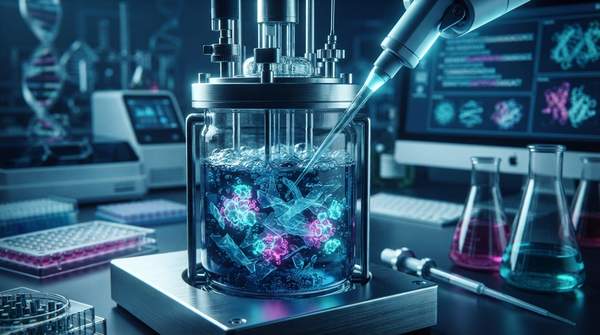
The biochemical pathway relies on living microorganisms — bacteria, archaea, or algae — to convert CO2 into valuable products such as fuels, proteins, and ethanol, as described in the OGCI report. Rather than forcing CO2 through chemical reactions, this approach essentially feeds the gas to microbes that metabolize it into organic compounds.
One emerging variant is gas electrofermentation, a technique examined in a KAUST-hosted research chapter on reactor and electrode design for producing biochemicals and biofuels from CO and CO2. The chapter discusses how syngas fermentation and microbial electrosynthesis — processes involving specialized microbes at a biocathode — can convert these gases into usable products. This is still a developing field, with researchers focused on improving the configuration and design of the reactors and electrodes that make the conversion efficient.
The OGCI report draws a sharp distinction within the biochemical category: biofuels made through algal synthesis remain uneconomical despite many years of research and development, given their high energy demand and land requirements. By contrast, CO2-based proteins and ethanol hold more potential to penetrate large existing markets. Microbial protein production is singled out as a promising new utilization pathway — one that could plug into established feed and food markets rather than needing to create demand from scratch.
Polymer Production: CO2 as a Building Block for Materials
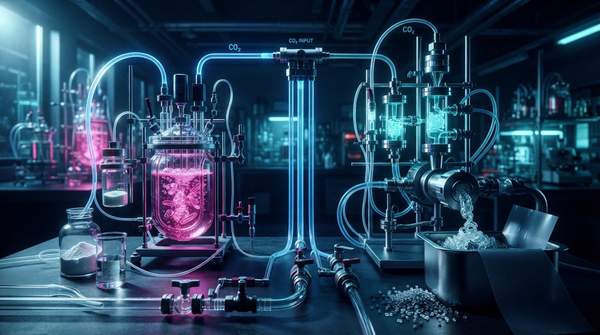
The polymer pathway is a chemical conversion approach: instead of microbes, it uses CO2 directly as a feedstock to synthesize materials. The OGCI report identifies five key end products made with captured CO2 — polycarbonates, polyols and polyurethanes, polyolefins, polyhydroxyalkanoates (PHA), and PET — each with differing market size and penetration. Producing polymers from captured CO2, the report notes, has the potential to develop into several small to medium-sized markets.
The best-documented example is polyol synthesis. A life cycle assessment published in Green Chemistry in 2014 by Niklas von der Assen and André Bardow examined an industrial case study of polyethercarbonate polyols made with CO2 as feedstock, noting that these polyols were already starting to be synthesized at industrial scale and can be further processed into polyurethanes, enabling CO2 to be utilized in large amounts.
That study also quantifies a real cost of the pathway: preparing the CO2 is energy-intensive. Because of the electricity needed for CO2 cleaning, compression, and filling, plus the work lost from solvent regeneration, the source power plant's electricity output to the grid was reduced by 265 kWh per ton of CO2 captured. On the other hand, the cleaned CO2 met the European Industrial Gases Association standard and food-grade quality, and construction of the capture facilities contributed only minimally to total life cycle impacts.
Comparing Key CO2 Utilization Pathways
The table below contrasts the two pathways side by side, drawing on the OGCI report, the Green Chemistry case study, and the gas electrofermentation research. The comparison shows that while both routes face significant energy demands, they differ fundamentally in mechanism and output: biological systems produce fuels, proteins, and ethanol, while chemical synthesis produces material feedstocks like polyols.
| Dimension | Biochemical Conversion | Polymer Production |
|---|---|---|
| Pathway category | Uses microorganisms — bacteria, archaea, or algae — to convert CO2 into valuable organic compounds | Uses CO2 as a chemical feedstock to synthesize polymers and intermediates |
| Core process | Gas fermentation and microbial electrosynthesis, including emerging gas electrofermentation systems converting CO and CO2 | Chemical synthesis of polyols for polyurethane production; cleaned, compressed CO2 meets food-grade quality standards |
| Example products | Biochemicals, biofuels, CO2-based proteins, and ethanol | Polyols for polyurethanes; broader family includes polycarbonates, polyolefins, PHA, and PET |
| Key considerations and limitations | Algal biofuels remain uneconomical due to high energy demand and land requirements; proteins and ethanol show stronger market potential | CO2 preparation is energy-intensive — 265 kWh per ton captured in the studied case — though capture facilities had minor life cycle impact |
| Market outlook | Earlier stage of development, with potential to be substantial by 2040 | Several small to medium-sized markets possible; polyols already synthesized at industrial scale |
Readers can use this comparison to match a pathway to a product type: if the goal is a food, feed, or fuel output, the biochemical route is the relevant family; if the goal is durable materials that lock CO2 into products, the polymer route applies. The energy penalty appears in both, but at different points — in cultivation and processing for biochemical routes, and in CO2 cleaning and compression for polymer routes.
Market and Policy Factors Driving CCU Adoption
Neither pathway scales on technical merit alone. A scientific review of CCUS technology published in PMC emphasizes that the economic viability and scalability of these technologies depend on heterogeneous technical details, costs, resources, and environmental conditions — factors that must be evaluated pathway by pathway rather than in aggregate.
The World Economic Forum, drawing on a report produced with Wood Mackenzie and insights from more than 30 industry leaders, developers, and policy experts, highlights that carbon pricing, mandates, and tax credits are crucial for overcoming cost barriers, and that stronger evidence of CCU's effectiveness is essential for building confidence and scaling the technology. The report frames the challenge as moving CCU from pilot initiatives to practical, broader industrial decarbonization strategies.
The OGCI report echoes this from the industry side, cataloguing the policy levers needed to make CO2-derived products economical: incentives for renewable energy and green hydrogen, regulation or incentives for CO2 content in the chemicals sector, public procurement programs for low-carbon building materials, and harmonized accounting rules for offsetting and selling carbon emissions. It also encourages companies to become early adopters of key CCU technologies to drive down costs. These levers, the report notes, are a subset of the policies required — but without them, the energy and cost penalties documented in both pathways remain hard to overcome.
Advancing CCU: Policy and Investment are Key
For CCU technologies to achieve large-scale adoption and contribute meaningfully to decarbonization, sustained policy support, including carbon pricing and R&D investment, is essential to overcome high initial costs and market immaturity. The biochemical and polymer pathways illustrate why: both convert CO2 into products with real markets — proteins, ethanol, and polyurethane components among them — but both carry energy penalties that current prices do not reward.
The measurable indicator to watch is increased government and corporate investment in CCU R&D, coupled with the implementation of supportive carbon pricing mechanisms or mandates. The OGCI's 2040 horizon for these two pathways reaching substantial markets gives observers a concrete timeline: progress toward that date will depend less on laboratory breakthroughs than on whether the policy levers the industry itself has identified — carbon pricing, procurement programs, and chemicals-sector incentives — are actually put in place.