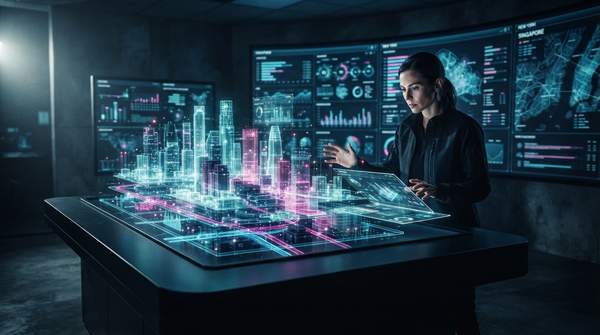
A digital twin of a city is a virtual, data-fed replica of a real urban environment that planners and managers can use to simulate scenarios, test decisions, and monitor change before acting on the physical city. It is not a single 3D map. As a scholarly model by Li Deren, Yu Wenbo, and Shao Zhenfeng describes, it is a layered system that gathers data from physical infrastructure, processes it on a cloud platform, and delivers it as management applications. Two cities illustrate the payoff: Singapore uses a full city-state model to simulate everything from wind around buildings to emergency evacuations, while New York City is building one aimed squarely at traffic congestion and road fatalities.
How a Smart City Digital Twin Works: A Layered View
The clearest way to understand a city-scale digital twin is to break it into three functional layers and trace how information flows from the street to a decision-maker's screen. The model below deconstructs the "Public Information Cloud Service Platform" — the infrastructure component of what the authors call a Smart City Operation Brain (SCOB) management architecture — into its three operating layers, then maps how data moves through them.
| Layer | Function | Components |
|---|---|---|
| Infrastructure / Data Layer | Acquires and stores urban data from physical sources | Servers, networks, sensor equipment, urban IoT, big data resource pool |
| Platform / Integration Layer | Processes data and provides services for developing and operating applications | Cloud infrastructure; data, platforms and software delivered as services; data collecting, processing, storing, cleaning, mining and feedback chain |
| Application / Service Layer | Delivers tools officials use to manage the city | Applications in smart urban management, smart public security, smart tourism and other fields |
The reasoning path runs bottom to top. Sensors, networks and servers in the infrastructure layer acquire raw data about the physical city. The platform layer then runs what the authors describe as an "ecological chain of data collecting, processing, storing, cleaning, mining, applying, and feedback" — turning raw inputs into usable, synchronized models. Officials, in the authors' words, "can just use the 'applications' of the platform to take the charge of management of the smart city." The smart city operation center built on the digital twin is, in their framing, "the heart of the smart city," serving as both the resource pool of urban big data and the hub of the urban IoT.
The key insight this framework delivers is that a digital twin is not a monolithic 3D model but a multi-layered system that gathers, processes, and utilizes data to enable specific city management functions like simulation and monitoring. The 3D visualization is only the visible surface; the value comes from the continuous loop between physical city, data platform, and management application.