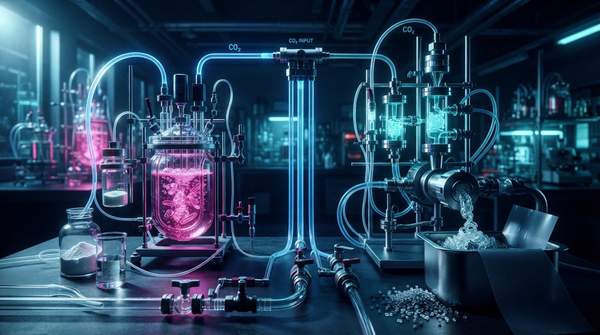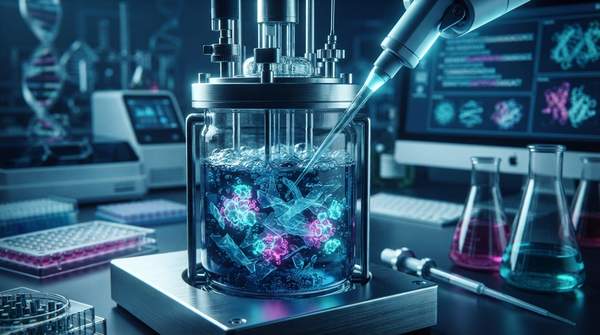
Synthetic biology is turning plastic-eating microbes from a laboratory curiosity into an engineered technology. The field's core insight is that nature already contains organisms able to decompose plastics, but they are rarely efficient enough to matter at industrial scale. The solution is a four-stage workflow: discover natural degraders, decode their genetic and metabolic machinery, engineer the key enzymes, and computationally optimize the whole system. Reviews of microbial plastic degradation describe how advances in synthetic biology have expanded bioremediation by enabling the engineering of microorganisms, enzymes, and responsive biological systems with improved degradation specificity and environmental adaptability.
Introduction: Synthetic Biology's Role in Plastic Remediation
Traditional remediation techniques primarily separate, transfer, or partially degrade pollutants, according to a comparative review of microplastic remediation strategies published in Frontiers in 2026 by Hening Guo and colleagues. Biological systems offer a different proposition: more selective and potentially sustainable remediation under relatively mild environmental conditions. The review argues that synthetic biology has expanded bioremediation capabilities precisely because it allows researchers to engineer organisms rather than merely deploy whatever nature provides.
That shift matters because plastic is a difficult target. Highly crystalline polymers resist enzymatic attack, and naturally occurring degraders work slowly. A review of synthetic biology's role in plastic depolymerization and upcycling, published by SCIEPUBLISH, points to emerging tools—high-throughput screening, evolutionary metabolic engineering, and bioinformatics for studying catalytic mechanisms—as the levers that could make biological degradation environmentally sustainable and economically feasible, supporting what the authors call a circular plastic economy.
Stage 1: Discovering Nature's Plastic Eaters
Everything begins with bio-prospecting: isolating microbial strains from natural environments that can decompose and bio-assimilate multiple types of plastic into harmless substances. The Wyss Institute, whose "Plastivores" project describes this workflow, treats the microbes' baseline capabilities as the foundation for everything that follows. Researchers search soil, waste sites, and other environments for organisms already adapted to consuming synthetic polymers.
The catalog of known degraders is broad. A review of bacterial plastic degradation published through PMC highlights representative genera including Thermobifida, Ideonella, Bacillus, Agromyces, Pseudomonas, and Schlegelella species. Writing in Polytechnique Insights, biologist Tania Louis notes that organisms capable of degrading plastics "may not be efficient enough to be useful on a large scale, but their study provides new ammunition for synthetic biology." Each enzyme discovered enriches the catalogue of tools available for designing metabolic pathways.
Stage 2: Unraveling Microbial Pathways with Multi-omics
Once a candidate strain is found, the question becomes how it actually breaks plastic down. Here the Wyss workflow relies on analytical chemistry and next-generation sequencing to characterize the microbe's plastic-metabolizing enzymes and pathways. This is not a single measurement but a suite of techniques: the PMC review emphasizes the significance of multi-omics tools—transcriptomics, proteomics, metabolomics, and genomics—in deepening understanding of microbial plastic degradation without depending on pure culture.
That last point is practically important. Many plastic-degrading organisms cannot be easily grown in isolation, which historically blocked their study. Multi-omics sidesteps the limitation by reading gene expression, protein inventories, and metabolic products directly from environmental samples. The result is a map of the key genes and metabolic pathways that facilitate degradation—the blueprint engineers will modify in the next stage.
Stage 3: Engineering Enzymes for Enhanced Degradation
The enzymes at the heart of this process include PETase, METase, esterase, and oxidoreductase, according to the PMC review, which focuses on the enzymatic and genetic aspects of bacterial degradation of synthetic polymers. PETase is the illustrative case: it hydrolyzes PET, the polyester behind most beverage bottles and synthetic textiles, cutting the polymer chain into its component monomers.
Engineering PETase is where the trade-offs appear. The Frontiers review by Guo and colleagues reports that PETase engineering has substantially improved PET hydrolysis, but thermostability "remains a mechanistically complex bottleneck rather than a simple parameter to maximize." PET depolymerization is favored near temperatures where PET chain mobility increases, yet that heat must be balanced against enzyme denaturation and heat-induced polymer recrystallization, both of which reduce hydrolysis efficiency. In other words, hotter is not automatically better: the polymer becomes easier to attack, but the enzyme can fall apart and the plastic can reorganize into a more crystalline, less degradable form. Louis's reporting reinforces the trajectory—modifying these proteins after studying their structure has sometimes yielded more efficient versions only a few years after their discovery.
The Four-Stage Workflow for Engineering Plastic-Degrading Microbes
Read together, the sources describe a generalized sequence rather than a single universal protocol. Each stage has a distinct goal and its own toolkit, and the output of one stage becomes the input to the next:
| Stage | Goal | Technologies | What it delivers |
|---|---|---|---|
| 1. Discovery | Find microbes that already decompose plastics | Bio-prospecting of natural environments | Baseline strains and enzymes to build on |
| 2. Analysis | Understand how degradation works genetically and metabolically | Analytical chemistry, next-generation sequencing, multi-omics (genomics, transcriptomics, proteomics, metabolomics) | A map of key genes, enzymes, and pathways |
| 3. Engineering | Improve depolymerization efficiency and specificity | Gene-specific and genome-wide engineering; structure-guided protein modification | Enhanced enzymes such as engineered PETase |
| 4. Optimization | Scale and adapt the system to real waste streams | AI and machine learning, bioinformatics, predictive modeling, activity-enhancing mutation design | A scalable, adaptable degradation platform |
The path is cumulative: a weakly effective natural isolate supplies the raw material, analysis reveals which parts matter, engineering improves them, and computational tools push the system toward industrial relevance. The SCIEPUBLISH review adds that optimizing microbial consortia interactions and developing efficient metabolic pathways for degradation products are part of the same engineering agenda.
Stage 4: Optimizing Performance with Computational Tools
The final stage is where the field is currently moving fastest. The PMC review illustrates how advanced biotechnological techniques and artificial intelligence participate in plastic biodegradation through enzyme engineering, activity-enhancing mutation design, predictive modeling, and omics data analysis. Machine learning can propose mutations no one would have tested by intuition, and models trained on omics data can predict which designs will survive real conditions.
A concrete example comes from the company Breaking, described by Eshaan Mani in the Harvard Technology Review. Breaking used machine learning, bioinformatics, and computational software to fully annotate the genome of its strain X-32 and increase its degradation efficiency. "Our understanding of the genes responsible for degradation allows us to adapt X-32 for different plastics, environments, and use cases," the company's founder noted, enabling precise engineering of the strain to target specific plastic waste streams across multiple industries.
Upcycling extends the logic one step further. Rather than treating degradation products as waste, synthetic biology aims to route the resulting monomers into biotransformation pathways that yield high-value commodities—the circular plastic economy the SCIEPUBLISH review envisions, in which biological depolymerization feeds chemical production instead of landfill.
Accelerating Plastic Remediation: A Path Forward
Synthetic biology offers a viable and evolving pathway to address plastic pollution by engineering biological systems for efficient degradation and upcycling. The evidence base carries caveats worth keeping in view: the workflow described here is a synthesis of steps from multiple scientific sources, a generalized model rather than a single universally applied protocol, and the claimed advantages of engineered bioremediation come from review-level analysis rather than head-to-head field comparisons with physical or chemical methods. Thermostability in PETase engineering remains an unsolved, mechanistically complex bottleneck.
The measurable indicator to watch is the increased deployment of engineered microbes in industrial plastic waste processing facilities or pilot projects. The Frontiers review by Guo and colleagues frames the field as shifting from passive biodegradation toward engineered systems with improved degradation specificity, environmental adaptability, and long-term remediation potential. Each announced pilot that moves an engineered strain or enzyme from the lab into a working waste stream will mark the next milestone in whether that shift becomes industrial reality.
Sources
- Frontiers | A comparative review of microplastic remediation strategies: constraints of physical…
- Synthetic Biology Boosts the Biological Depolymerization and Upcycling of Waste Plastic Resources — SCIEPUBLISH
- Plastivores: Plastic-Degrading Super-Microbes and Enzymes — Wyss Institute
- Harnessing bacterial power and omics technologies for sustainable plastic waste biodegradation - PMC
- How synthetic biology could help degrade plastic waste - Polytechnique Insights