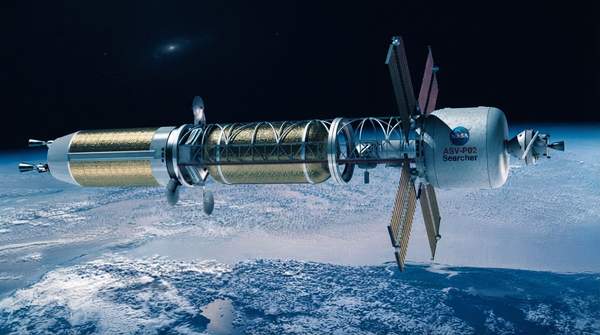
Nuclear space propulsion comes in two fundamentally different forms, and the choice between them comes down to a single trade-off: thrust versus efficiency. Nuclear Thermal Propulsion (NTP) delivers high thrust with roughly twice the propellant efficiency of chemical rockets, making it the leading candidate for rapid crewed transits to Mars. Nuclear Electric Propulsion (NEP) produces only low thrust but with far greater propellant efficiency still, allowing it to push spacecraft steadily for months or years—ideal for long-duration robotic missions to the outer solar system.
The Need for Nuclear Propulsion in Deep Space
Chemical propulsion has carried every crewed mission from Apollo to Artemis, and NASA expects it to remain the workhorse for launching payloads from Earth because of its continued technical and economic advantage. But chemistry has a hard ceiling. A rocket burning liquid hydrogen and liquid oxygen achieves a specific impulse—the standard measure of propellant efficiency—of about 450 seconds, and no refinement of the chemistry changes that limit.
Beyond Earth orbit, the constraints bite harder. Solar arrays fade with distance from the sun, and according to the Australian Nuclear Science and Technology Organisation, photovoltaic systems are unsuitable for the outer solar system, making nuclear propulsion the only practical technology for missions to those regions. Nuclear systems also offer solar-independent power for years with minimal need for refueling or maintenance, as NASA notes. The result is that two reactor-based concepts have emerged to fill the gap: one that uses heat directly, and one that uses electricity.