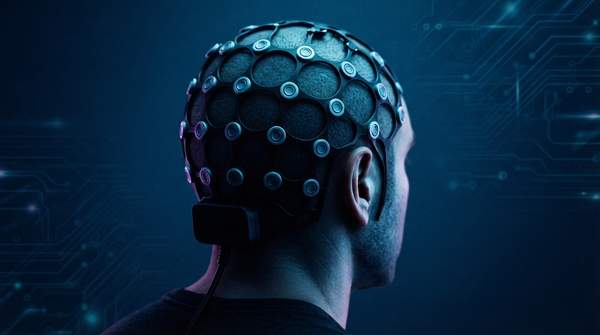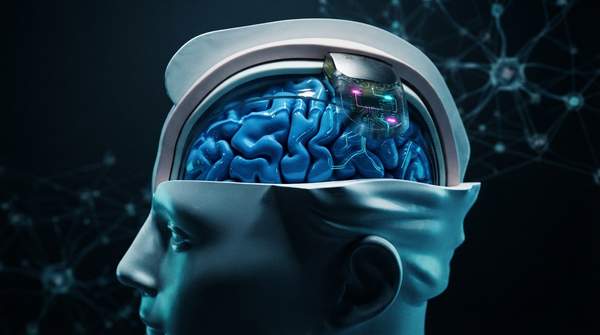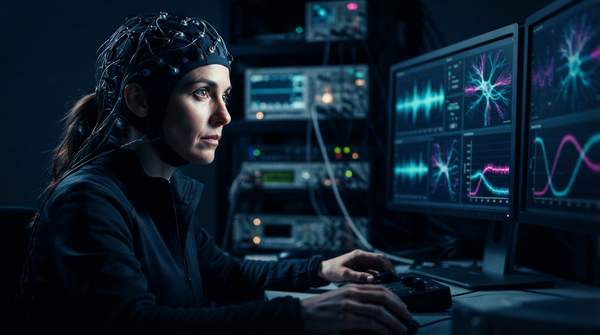
Brain–computer interface training works because it turns a thought into a consequence—and the brain, treating that consequence as evidence, gradually reorganizes itself around it. When a user imagines a movement, an EEG-based system decodes the accompanying neural activity into a command, drives an external device, and returns sensory feedback. If that feedback arrives within roughly 100 milliseconds of the motor intent, the conditions for Hebbian plasticity are met: the neural pathways that produced the intent are strengthened because they fired in synchrony with meaningful sensory input. Modern closed-loop and co-adaptive systems are built around exactly this timing, and evidence from multi-day motor imagery experiments shows they measurably improve how quickly users gain control.
The BCI Neuroplasticity Feedback Loop
Every non-invasive BCI shares the same basic anatomy, as the University of Calgary's Cumming School of Medicine explains in its primer on the technology. Brain activity is first recorded, then processed by software that interprets the user's intended action from the incoming signal. A command is then sent to the application or device being controlled, and finally the system feeds back to the user what it was able to interpret—whether, for instance, a lamp actually switched on.
That last step is not a courtesy; it is the engine of learning. Feedback, the Calgary primer notes, helps the user adapt to the system, learning to control and adjust their own brain activity much as a person learns to coordinate muscles. A review of post-stroke BCI rehabilitation by Yufeng Chen and colleagues at Frontiers in 2026 frames the same cycle in neurophysiological terms: BCIs decode neural signals—primarily EEG—in real time and translate them into control commands, giving patients with motor disorders an active role in rehabilitation training.
The loop is genuinely cyclical. Each successful translation tells the brain which patterns were worth producing; each failed translation tells it which were not. Over repetitions, the user's neural activity patterns and the decoder's expectations converge on a shared, reliable code.