Speech brain-computer interfaces do not read minds. They eavesdrop, with permission and surgical precision, on a very specific stretch of the brain's traffic: the motor signals that would normally command the jaw, lips, tongue, and larynx to produce words. Every working thought-to-speech system follows the same three-stage chain—record the neural activity, decode it into a linguistic or articulatory representation, and synthesize that representation into sound. Where the field genuinely diverges is the middle stage, where two competing scientific strategies are racing to solve the same problem.
Stage 1: Recording Neural Signals
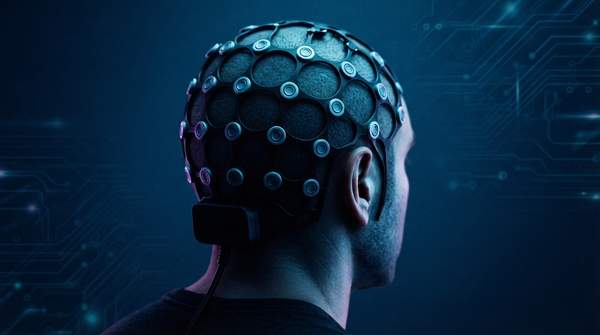
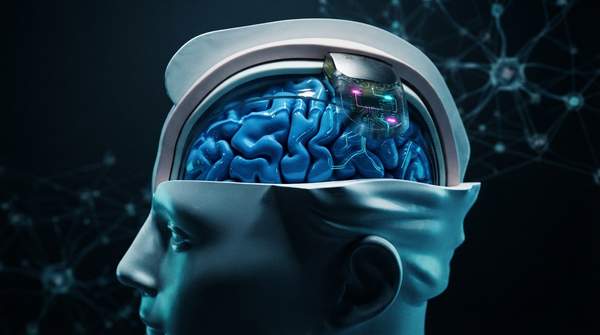
The chain begins with hardware. Stanford Medicine describes a brain-computer interface that uses tiny arrays of microelectrodes—each array smaller than a baby aspirin—surgically implanted in the brain's surface layer to record neural activity patterns directly. Those signals travel through a cable hookup to a computer, where algorithms translate them into actions such as speech or cursor movement.
Not every system uses the same sensing hardware. A UC Berkeley team behind a brain-to-voice neuroprosthesis showed its decoding approach works across a variety of interfaces, including microelectrode arrays whose electrodes penetrate the brain's surface, and even non-invasive surface sensors that measure facial muscle activity. As Berkeley Ph.D. student and co-lead author Kaylo Littlejohn put it, the technique is not limited to one specific type of device—the same algorithm can be used across different modalities provided a good signal is there.
What matters more than the specific sensor is where it listens. The Berkeley neuroprosthesis samples neural data from the motor cortex, the part of the brain that controls speech production. That anatomical choice defines what the entire downstream pipeline can and cannot know, a point that becomes clear when we examine what these signals actually contain.
Stage 2: Decoding Intent – The Core Challenge
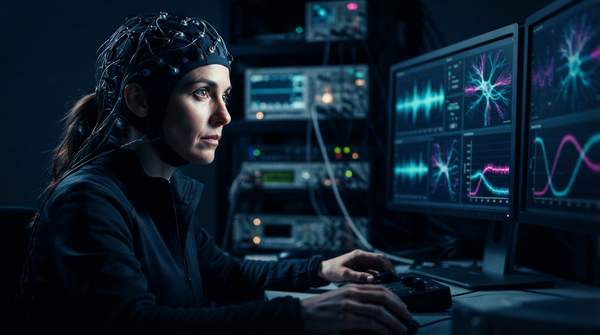
Raw neural recordings are, by themselves, meaningless to a computer. The decoding stage is where machine learning converts them into something a speech synthesizer can use, and it is the hardest problem in the field. The computer must learn, from examples, which patterns of neural activity correspond to which intended outputs—and it must do this in real time for a signal that is noisy, high-dimensional, and unique to each person's brain.
The architectures researchers reach for are the same ones driving the broader AI boom. IEEE Spectrum, reporting on work by neurosurgeon Edward Chang's lab, notes that a string of efforts has applied neural networks—algorithms loosely modeled after the human brain, often used in deep learning—to interpret sound from brain activity, with independent teams at Northwestern and Columbia publishing neural-network-based speech reconstruction in the Journal of Neural Engineering and Scientific Reports.
Architectural choices are still being actively contested. A recent end-to-end brain-to-text effort argues that modern transformers may better capture complex neural representations and enhance decoding performance, citing work by Feghhi and colleagues that incorporated transformers to decode phonemes with time masking to mitigate overfitting. Meanwhile, a NeurIPS 2025 paper on hybrid state-space models reports decoding accuracy comparable to state-of-the-art transformers at a fraction of the inference cost—up to nine times faster on GPU—on tasks including speech decoding in human subjects. For a device that must respond in conversational time, that speed-accuracy trade-off is not academic; it is the difference between a usable and unusable conversation.
Decoding Approaches: Phonemes vs. Vocal Tract Modeling
Two primary strategies dominate the decoding stage, and they differ in what they treat as the fundamental unit of speech.
The first is phoneme-based decoding. Stanford's approach uses machine learning to train the computer to recognize repeatable patterns of neural activity associated with each phoneme—the tiniest units of speech—and then stitches the phonemes into sentences. This approach focuses on linguistic units: the system's intermediate representation is language itself, and the algorithm's job is to classify neural patterns into discrete speech sounds that can be assembled into words.
The second is vocal tract modeling. Rather than asking "which sound is being intended?", it asks "how is the mouth about to move?" Brain signals are decoded into movements of the vocal tract—jaw, lips, tongue—before speech is synthesized from those movements. A neural speech decoding framework published in Nature Machine Intelligence describes decoding cortical activity into an articulatory movement space that is then transformed into speech, an approach the authors note provides robust decoding performance but with a non-natural synthetic voice reconstruction. Conversely, they observe, approaches producing more naturalistic reconstruction—using WaveNet vocoders, generative adversarial networks, and unit selection—achieve limited accuracy.
That trade-off is the field's central tension in miniature. The articulatory route is robust because it mirrors how the brain actually organizes speech; the direct-synthesis route sounds more human but decodes less accurately. Neither approach has definitively won, and the conceptual difference between them—decoding language versus decoding movement—is the clearest map a reader can hold of the field's two scientific paths.
The Three Stages of Thought-to-Speech BCI
Putting the pieces together, the full signal chain from intention to audible word runs as follows:
| Stage | What happens | Key technologies |
|---|---|---|
| 1. Recording | Microelectrode arrays implanted in or on the brain's surface record neural activity patterns from the motor cortex, which controls speech production. | Microelectrode arrays; in some systems, penetrating electrodes or non-invasive facial muscle sensors |
| 2. Decoding | Machine learning translates neural activity into either phonemes (linguistic units) or vocal tract movements (articulatory parameters). | Neural networks including transformers, recurrent architectures, and hybrid state-space models |
| 3. Action (Synthesis) | The decoded linguistic or articulatory representation is converted into audible speech. | Speech synthesizers, including WaveNet-style vocoders and generative adversarial networks |
Reading the table as a chronology: a person decides what to say, the implanted array captures the resulting motor-cortical activity, the decoding algorithm classifies that activity into phonemes or articulatory movements, and the synthesizer renders the result as sound. Each stage depends entirely on the quality of the one before it—no decoding algorithm can recover information the sensor never captured.
Beyond 'Mind Reading': Decoding Motor Intentions
The most common misconception about speech BCIs is that they expose inner monologue. The evidence says otherwise. Cheol Jun Cho, co-lead author of the Berkeley study, explains that the neuroprosthesis works by intercepting signals where the thought is translated into articulation, in the middle of motor control. "So what we're decoding is after a thought has happened, after we've decided what to say, after we've decided what words to use and how to move our vocal-tract muscles," he said.
In other words, the system targets motor intentions for speech, not abstract thoughts. The brain has already finished the deliberative work—choosing words, planning the sentence—before the relevant signals appear in the motor cortex. What the implant captures is the output of that decision: the motor command pattern that would normally drive the vocal muscles.
This is also why training is user-specific and unavoidable. Stanford's approach requires machine learning to train the computer to recognize repeatable patterns of neural activity associated with each phoneme, meaning each person's device must learn their brain's individual neural signature for speech. The device is not born understanding anyone's speech; it is taught, one user at a time.
Stage 3: Generating Synthetic Speech
The final stage converts the decoder's output into sound. In phoneme-based systems, the identified phonemes are stitched into sentences and rendered by a speech synthesizer. In articulatory systems, the decoded vocal tract movements feed a synthesis model that reconstructs the acoustic result of those movements.
The choice of synthesis technology shapes how the result sounds. The Nature Machine Intelligence framework notes that some approaches have produced naturalistic reconstruction leveraging WaveNet vocoders, generative adversarial networks, and unit selection—but at the cost of limited accuracy, while the more robust articulatory route yields a less natural synthetic voice. Speed matters here too: a bioRxiv preprint on neural decoding of speech using deep neural ensembles reports that a relay architecture reduced neural data readout time by 91.2 percent, with a mean of 228 milliseconds—engineering work aimed squarely at making the final stage fast enough for real conversation.
Latency and naturalness, not just accuracy, are what a paralyzed user actually experiences. As the BCI developer Paradromics frames it, "These are the stakes behind every bit per second and every millisecond of latency." The company, which notes that several speech BCI systems are currently in clinical trials, adds that the work ahead is "not only technical but human: building systems that are faster, more accurate, and more powerful in partnership with the people who will actually rely on them."
Advancing Communication: The Path Forward for Speech BCIs
Continued research and development in speech BCI technology are crucial for restoring communication for individuals with severe paralysis or speech impairments. The technology is not mind reading and not a finished product; it is a trained partnership between a person's motor cortex and a learning algorithm, with two competing decoding philosophies—phonemes and vocal tract movements—still vying to produce the most accurate and naturalistic speech.
The measurable indicator to watch is the increasing number of clinical trials and the publication of new research demonstrating higher accuracy and more naturalistic speech synthesis. Several speech BCI systems are already in clinical trials, and each published study that pushes decoding accuracy upward or synthesis latency downward marks the field's next concrete milestone on the path back to speech for those who have lost it.